|
 |
 |
 |
 |
 |
 |
 |
 |

 |
On Mars No One Can Hear You Scream
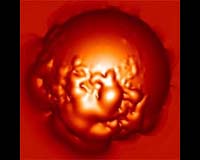
University Park PA (SPX) Jul 10, 2006 It may be difficult for two people to have a conversation on Mars, according to a research paper by Amanda Hanford and Lyle Long of the aerospace engineering department at Penn State University. "Sound doesn't travel very far on Mars," explained Hanford, whose work is detailed in the paper, "Computer Simulations of the Propagation of Sound on Mars," which she recently presented at the 151st Acoustical Society of America meeting in Providence, R.I. Using a Direct Simulation Monte Carlo method, Hanford and Long took into account the Martian atmospheric composition, as well as the lower atmospheric pressure of Mars and temperature differences. "In studying sound on Mars, the physical properties of sound are the same," Hanford said, adding that Earth and Mars also share some physical similarities. The simulation predicted sound on Mars has a lower pitch and very short distance. She said a sound's lower pitch is the result of the differences in the speed of sound. This is because of the red planet's atmospheric makeup - mostly carbon dioxide, with small percentages of nitrogen and argon with trace amounts of water vapor and oxygen. "When you breathe in a helium balloon and speak, your voice is a high pitch," Hanford explained. "Assuming you could breathe in carbon dioxide (which is very toxic), your voice would be a lower pitch." The distance sound can travel is also greatly affected by the Martian atmosphere. "The lower pressure makes it so sound doesn't travel far," she said. According to the paper, sound generated by a human scream on Earth can travel a little over 1 kilometer (0.6 mile) before being absorbed completely by the atmosphere. On Mars, the sound from that same scream would only move about 16 yards at best. Hanford created a downloadable movie clip of a DSMC-simulated sound wave propagating in the Martian atmosphere and its rate of decay. The last attempt to record sound on Mars was part of the NASA's Mars Polar Lander, launched in January 1999. The probe included a miniature microphone to record sounds on the Martian surface. Communication with the lander was lost after it entered the Martian atmosphere on Dec. 3, 1999. Community Email This Article Comment On This Article Related Links Acoustics Clip Penn State Mars News and Information at MarsDaily.com Lunar Dreams and more
 Spirit Copes With Decreasing Solar Energy
 Pasadena CA (SPX) Jul 07, 2006
With electrical power from Spirit's solar array down to about 300 watt-hours per Martian day, or sol, the science team is able to plan only one major activity per sol and often needs to devote one sol to recharging the rover's batteries. |
|
|

| The content herein, unless otherwise known to be public domain, are Copyright 1995-2006 - SpaceDaily.AFP and UPI Wire Stories are copyright Agence France-Presse and United Press International. ESA PortalReports are copyright European Space Agency. All NASA sourced material is public domain. Additionalcopyrights may apply in whole or part to other bona fide parties. Advertising does not imply endorsement,agreement or approval of any opinions, statements or information provided by SpaceDaily on any Web page published or hosted by SpaceDaily. Privacy Statement |