|
 |
 |
 |
 |
 |
 |
 |
 |

 |
Spirit Update: Soon To Find Winter Resting Place
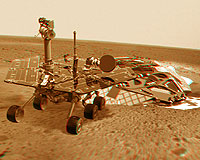
Pasadena CA (SPX) Dec 20, 2007 To make the most of waning sunlight during the approach of Martian winter, Spirit's handlers have returned to "Mars time." This means their working hours coincide with the Martian day, as they did for the first three months after the rover landed on the red planet. Because a Martian day is about 40 minutes longer than an Earth day, Mars time can coincide with all hours of the day and night on Earth. The alarm might go off the same time one day, 40 minutes later the next day, an hour and 20 minutes later the next day, and so on. Spirit's solar power levels continue to drop, with solar array energies recently ranging from 293 watt-hours to 254 watt-hours, depending on the vehicle's orientation relative to the Sun. (One hundred watt-hours is the amount of energy needed to light a 100-watt bulb for one hour.) All members of the rover science team -- drivers, engineers, and scientists -- are evaluating data to select a place where the rover will attempt to survive another Martian winter, focusing on areas that will tilt the rover's solar panels to the north more than 25 degrees. They will select a final location from a narrowed list of choices based on proximity to the rover's current position and the characteristics of the terrain, with an eye for accessibility as well as continued exploration in the spring. Spirit reached the northern edge of "Home Plate" after driving 13.24 meters (43.44 feet) on Martian day, or sol, 1397 (Dec. 8, 2007). Three Martian days later, on sol 1400 (Dec. 11, 2007), Spirit finished collecting reconnaissance images of the northern exposure of the elevated plateau. During the past week, rover planners got a special visit from two Tuskegee Airmen, the first black pilots to serve in the U.S. military. The pilots shared stories about serving in World War II while learning about rover operations. Sol-by-sol summary: In addition to receiving morning instructions directly from Earth via the high-gain antenna, sending evening data to Earth at UHF frequencies via the Odyssey orbiter, and measuring atmospheric dust levels with the panoramic camera, Spirit completed the following activities: Sol 1398 (Dec. 9, 2007): Spirit drove 6.5 meters (21.3 feet) in a path nearly parallel to the northern edge of Home Plate. The rover acquired post-drive images with the hazard avoidance cameras and a mosaic of images with the navigation camera. Sol 1399: Spirit drove 7.19 meters (23.6 feet) toward a small promontory to acquire images of the slopes below. The rover acquired post-drive images with the hazard avoidance cameras and a mosaic of images with the navigation camera. The following morning, Spirit acquired a series of navigation camera images to complete a 360-degree view of the rover's location after completing the drive. Sol 1400: Spirit nudged 0.75 meter (2.5 feet) closer to the edge of Home Plate for a better view of what lay below. The rover acquired post-drive images with the hazard avoidance cameras and a mosaic of images with the navigation camera. Sol 1401: Spirit took a break from driving and acquired images with the panoramic camera before turning around to back down the steep slope where the rover will spend the winter. After turning, the rover's solar arrays blocked the view of the slope by cameras on the rover mast assembly. Following the maneuver, Spirit acquired two image mosaics with the panoramic camera. Sol 1402: Spirit acquired a pre-drive image of a pointy rock known as "General B.O. Davis" before backing up 2.5 meters (8.2 feet) and turning 180 degrees. The rover acquired post-drive images using the hazard avoidance cameras and a mosaic of images using the navigation camera. The following morning, Spirit monitored dust on the panoramic camera mast assembly and completed a systematic ground survey and a survey of rock clasts with the panoramic camera. Sol 1403 (Dec. 14, 2007): Plans called for Spirit to approach the edge of Home Plate backward and acquire post-drive images with the hazard avoidance cameras as well as an image mosaic with the panoramic camera. Odometry: As of sol 1402 (Dec. 13, 2007), Spirit's total odometry was 7523.31 meters (4.67 miles). Community Email This Article Comment On This Article Related Links Mars News and Information at MarsDaily.com Lunar Dreams and more
 The Closest Approach Of Mars In 2007
 Pasadena CA (SPX) Dec 19, 2007
Now playing online -- a new Martian movie showing the planet rotating. The movie was made from four images taken by the Hubble Space Telescope's Wide Field Planetary Camera 2, built and designed by JPL. The images were taken within 36 hours of today's closest approach to Earth by Mars. The camera captured the views when Mars was just 88 million kilometers (55 million miles) away. |
|
|

| The content herein, unless otherwise known to be public domain, are Copyright 1995-2007 - SpaceDaily.AFP and UPI Wire Stories are copyright Agence France-Presse and United Press International. ESA Portal Reports are copyright European Space Agency. All NASA sourced material is public domain. Additional copyrights may apply in whole or part to other bona fide parties. Advertising does not imply endorsement,agreement or approval of any opinions, statements or information provided by SpaceDaily on any Web page published or hosted by SpaceDaily. Privacy Statement |