|
 |
 |
 |
 |
 |
 |
 |
 |

 |
South Korea Successfully Tests Longer-Range Cruise Missile
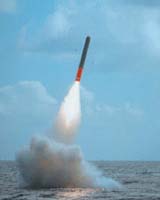
Seoul (AFP) Oct 24, 2006 South Korea has successfully tested a new longer-range cruise missile which has not only North Korea but also parts of China and Japan within range, a news report said Tuesday. The Munhwa Ilbo newspaper, quoting unnamed senior government officials, said the country had succeeded in test-firing a cruise missile with a 1,000 kilometer (620-mile) range. "The missile precisely hit the targeted zone, five meters in diameter, during the test launch," an unnamed official was quoted as saying. The missile had to shuttle 25 times between a launch site and a target around 40 kilometers away before hitting it to replicate the long distance range, another official told the paper. Defense ministry officials refused to confirm the report. South Korea has vowed to step up efforts to develop missiles that can launch surgical attacks on missile launching sites deep inside North Korea since its declared nuclear test on October 9. The new missile can reach all of North Korea as well as Beijing and Tokyo. The unnamed official said Seoul was also developing cruise missile with a range of 1,500 kilometers. South Korea's media reported last month the country had successfully developed its first cruise missile with a 500-kilometer range. Seoul's defense officials declined to confirm the reports. The new missile, tentatively named "Cheon Ryong" or Sky Dragon and similar to the US-made Tomahawk, will be deployed for operations by the end of the year, Yonhap news agency said Tuesday. A US-South Korean defence accord imposes a maximum range of 300 kilometers for Seoul's missiles, in compliance with international arms control efforts. But South Korean officials believe the agreement applies only to ballistic and not cruise missiles, according to media reports. The North deploys Scuds and Rodongs with a range of 1,300 kilometres, capable of hitting anywhere in the South, and is developing a Taepodong missile with an expected final range of up to 6,000 kilometres.
Source: Agence France-Presse Community Email This Article Comment On This Article Related Links All about missiles at SpaceWar.com Learn about missile defense at SpaceWar.com All about missiles at SpaceWar.com
 Breakthrough Could Lead To New Warhead Technologies
 Arlington VA (AFNS) Oct 19, 2006
An Air Force Research Laboratory Munitions Directorate science and engineering team has made a significant breakthrough in its hypersonic computational research, which could lead to new warhead technologies. Funded by the Air Force Office of Scientific Research here, the team is studying the aerodynamic characteristics of projectiles that deform at hypersonic speeds at sea level conditions, which is a high-speed flight regime not commonly studied. |
|
|

| The content herein, unless otherwise known to be public domain, are Copyright 1995-2006 - SpaceDaily.AFP and UPI Wire Stories are copyright Agence France-Presse and United Press International. ESA PortalReports are copyright European Space Agency. All NASA sourced material is public domain. Additionalcopyrights may apply in whole or part to other bona fide parties. Advertising does not imply endorsement,agreement or approval of any opinions, statements or information provided by SpaceDaily on any Web page published or hosted by SpaceDaily. Privacy Statement |