|
 |
 |
 |
 |
 |
 |
 |
 |

 |
Soot From Wood Stoves Impacts Global Warming More Than Expected
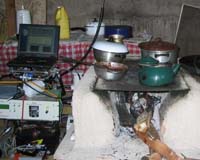
Washington DC (SPX) Oct 25, 2006 New measurements of soot produced by traditional cook stoves used in developing countries suggest that these stoves emit more harmful smoke particles and could have a much greater impact on global climate change than previously thought, according to a study scheduled to appear in the Nov. 1 issue of the American Chemical Society journal Environmental Science and Technology. Perhaps as many as 400 million of these stoves, fueled by wood or crop residue, are used daily for cooking and heating by more than 2 billion people worldwide, according to the study's lead authors, Tami Bond, Ph.D., and doctoral candidate Chris Roden of the University of Illinois, Urbana-Champaign. In a field test in Honduras, the researchers found that cook stoves there, which are similar to those used in other developing nations, produce two times more smoke particles than expected, based on previous laboratory studies. These dark, sooty particles, which are darker than those produced by grassland or forest fires, have a climate warming effect because they absorb solar energy and heat the atmosphere, according to Roden. In earlier work, Bond estimated that burning firewood -- the principal fuel for cook stoves in the developing world -- produces 800,000 metric tons of soot worldwide each year. In comparison, diesel cars and trucks generate about 890,000 metric tons of soot annually. These two sources each account for about 10 percent of the soot emitted into the world's atmosphere each year, she said. In addition to its environmental effects, smoke from cook stove fires is a major cause of respiratory problems, eye infections and tuberculosis, according to the researchers. "Emissions from wood cook stoves affect the health of users -- especially of women and children -- neighborhood air quality, and global climate. Reducing these emissions, through the use of cleaner burning stoves and fuels, should have far-reaching benefits," Bond said. In the past, scientists have relied on laboratory measures of pollutants from cooking fires because field tests have been difficult to conduct, in part, because of limited access to remote locations and a lack of power to operate the scientific equipment, according to Roden. To get a more accurate measure of the environmental impact of these stoves, Roden and Bond developed a portable battery-operated sampling cart, which includes sensors for measuring carbon dioxide and carbon monoxide, particle soot absorption, particle color and concentration, which they took to Honduras for field tests. Honduras is typical of Central American countries, where more than 80 percent of families cook their meals over open wood fires, according to Trees, Water and People, an American nonprofit agency which, along with the Honduran Association for Development, helped facilitate this study. In most cases, these families can't afford or don't have access to electricity, gas or alternative fuel sources. "We expected field measurements to be different from lab measurements, and we suspected the amount of black carbon from these stoves would be higher than open burning, but we were surprised by how much," Roden said. Trees, Water and People and other nonprofit agencies are distributing new low-cost, wood-burning cook stoves in Honduras and other Latin American countries that appear to be less polluting and more fuel efficient, according to the researchers. However, further analysis is needed. "Designing and distributing improved cook stoves may be an effective method of mitigating global climate change, and can improve the health of the users," Roden said. "However, the cook stoves must be well designed and properly tested. They must be built with local traditions and practices in mind and must be easy to use, or they may become expensive doorstops." Community Email This Article Comment On This Article Related Links American Chemical Society Learn about Climate Science at TerraDaily.com Climate Science News - Modeling, Mitigation Adaptation
 Australia Pumps More Cash Into Drought-Hit Farms
 Canberra (AFP) Oct 24, 2006
Australia will pump more cash into a multi-billion dollar relief package for farmers as the worst drought in living memory threatens economic growth, the government said Tuesday. An extra 560 million dollars (420 million US) in drought assistance will be extended to a further 44 farming regions scorched by the six-year "big dry", Deputy Prime Minister Mark Vaile said. |
|
|

| The content herein, unless otherwise known to be public domain, are Copyright 1995-2006 - SpaceDaily.AFP and UPI Wire Stories are copyright Agence France-Presse and United Press International. ESA PortalReports are copyright European Space Agency. All NASA sourced material is public domain. Additionalcopyrights may apply in whole or part to other bona fide parties. Advertising does not imply endorsement,agreement or approval of any opinions, statements or information provided by SpaceDaily on any Web page published or hosted by SpaceDaily. Privacy Statement |