|
 |
 |
 |
 |
 |
 |
 |
 |

 |
Singapore Should Conduct Long-Term Earthquake Study
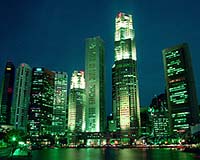
Singapore (AFP) Jan 19, 2006 Singapore should conduct a long-term study on the impact of earthquakes on the city-state, Southeast Asia's commercial hub where key facilities are built on reclaimed land, a top US scientist says. James Rice, a visiting Harvard University earthquake expert, said the study should focus on how structures built on reclaimed land would be affected by a major quake. Large areas of land-scarce Singapore have been reclaimed from the sea. "You have this massive container cargo port, you have fuel handling facilities, you have energy generation -- all in this fringe of marginal reclaimed land, which is land that greatly amplifies earthquake shaking," Rice told reporters ahead of a public lecture to be delivered Friday. Rice said "the critical thing to understand in Singapore is what would be the response of structures on that reclaimed land" during an earthquake and how to predict the level of shaking to guide urban planners. "When I look around Singapore, I don't see where anyone is going to build much... so presumably in the future much of what's done is going to be on further reclaimed land." Because of its sheltered geographical location Singapore is unlikely to be hit by tsunamis as big as the earthquake-triggered waves that hammered Indian Ocean coastlines on December 26, 2004, Rice said. The 9.3-magnitude quake off Indonesia's Aceh province in northern Sumatra triggered tsunamis which killed an estimated 220,000 people in countries around the Indian Ocean. Most of the victims were in Aceh. But Rice said Singapore remains within range of shockwaves from any earthquake off Sumatra's western coast, where major quakes occur every 200 to 300 years. A quake measuring 9.0 on the Richter scale occurred on the western coast of Sumatra -- the point where quake shockwaves would most strongly affect Singapore -- in 1833. Rice is in Singapore to deliver a public lecture at the National University of Singapore (NUS) about his studies of the Great Sumatran Fault, which runs through the Indonesian island. While some research on earthquakes has been done by the civil engineering department at NUS, these were mostly one-off projects. "There is no cohesive national thrust in looking into the effects of earthquakes," said Lee Fook Hou, an associate professor at the school's civil engineering department. Rice said a sustained study was necessary because Singapore's situation is "roughly analogous" to that of Mexico City, which was devastated by an earthquake in 1985 because it was built on an old lakebed. "You have extensive areas of marine clays, soft sediments, reclaimed land and you're going to have more," he said. Singapore should not rely on its experience as a modern nation to think it was immune from the threat of a major earthquake off Sumatra's western coast, Rice said. Rice noted that US scientists learned that Los Angeles was built on "terribly treacherous ground" only in the 1970s as the faults under the city had been inactive following a big earthquake on the San Andreas fault in 1857. "It's just what happens when you put cities up fast -- you don't get a good picture of the seismic environment that you live in," Rice said.
Source: Agence France-Presse Community Email This Article Comment On This Article Related Links Tectonic Science and News
 Earthquakes Kill Nearly 90,000 In 2005
 Washington DC (SPX) Jan 17, 2006
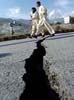
Although there were fewer deaths worldwide in 2005 due to earthquakes, more than 89,353 casualties were reported, according to the U.S. Geological Survey (USGS) and confirmed by the United Nations Office for Coordination of Humanitarian Affairs (OCHA). Nearly all of the fatalities for the year, more than 87,000, occurred when a magnitude 7.6 hit Pakistan on Oct. 8. |
|
|

| The content herein, unless otherwise known to be public domain, are Copyright 1995-2006 - SpaceDaily.AFP and UPI Wire Stories are copyright Agence France-Presse and United Press International. ESA PortalReports are copyright European Space Agency. All NASA sourced material is public domain. Additionalcopyrights may apply in whole or part to other bona fide parties. Advertising does not imply endorsement,agreement or approval of any opinions, statements or information provided by SpaceDaily on any Web page published or hosted by SpaceDaily. Privacy Statement |