|
 |
 |
 |
 |
 |
 |
 |
 |

 |
Silicon Nanoparticles Enhance Performance Of Solar Cells
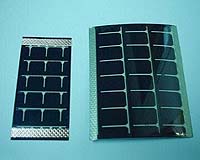
Champaign IL (SPX) Aug 21, 2007 Placing a film of silicon nanoparticles onto a silicon solar cell can boost power, reduce heat and prolong the cell's life, researchers now report. "Integrating a high-quality film of silicon nanoparticles 1 nanometer in size directly onto silicon solar cells improves power performance by 60 percent in the ultraviolet range of the spectrum," said Munir Nayfeh, a physicist at the University of Illinois and corresponding author of a paper accepted for publication in Applied Physics Letters. A 10 percent improvement in the visible range of the spectrum can be achieved by using nanoparticles 2.85 nanometers in size, said Nayfeh, who also is a researcher at the university's Beckman Institute. In conventional solar cells, ultraviolet light is either filtered out or absorbed by the silicon and converted into potentially damaging heat, not electricity. In previous work, however, Nayfeh showed that ultraviolet light could efficiently couple to correctly sized nanoparticles and produce electricity. That work was reported in the August 2004 issue of the journal Photonics Technology Letters. To make their improved solar cells, the researchers began by first converting bulk silicon into discrete, nano-sized particles using a patented process they developed. Depending on their size, the nanoparticles will fluoresce in distinct colors. Nanoparticles of the desired size were then dispersed in isopropyl alcohol and dispensed onto the face of the solar cell. As the alcohol evaporated, a film of closely packed nanoparticles was left firmly fastened to the solar cell. Solar cells coated with a film of 1 nanometer, blue luminescent particles showed a power enhancement of about 60 percent in the ultraviolet range of the spectrum, but less than 3 percent in the visible range, the researchers report. Solar cells coated with 2.85 nanometer, red particles showed an enhancement of about 67 percent in the ultraviolet range, and about 10 percent in the visible. The improved performance is a result of enhanced voltage rather than current, Nayfeh said. "Our results point to a significant role for charge transport across the film and rectification at the nanoparticle interface." The process of coating solar cells with silicon nanoparticles could be easily incorporated into the manufacturing process with little additional cost, Nayfeh said. With Nayfeh, the paper's co-authors are graduate student and lead author Matthew Stupca at Illinois, professor Mohamed Alsalhi at King Saud University in Saudi Arabia, and professors Turki Al Saud and Abdulrahman Almuhanna, both at the King Abdulaziz City for Science and Technology in Saudi Arabia. The research was funded by the National Science Foundation, the state of Illinois, the Grainger Foundation and the University of Illinois. Community Email This Article Comment On This Article Related Links University of Illinois at Urbana-Champaign All About Solar Energy at SolarDaily.com
 Indian PM Says Government Committed To Both Solar And Nuclear Power
 New Delhi, India (RIA Novosti) Aug 21, 2007
India's government is committed to the development of both nuclear and solar power, Prime Minister Manmohan Singh said Monday. The premier has come under pressure from communist allies in parliament over a nuclear energy deal with the United States, which is set to give India access to U.S. nuclear fuel and equipment for the first time since the 1970s. |
|
|

| The content herein, unless otherwise known to be public domain, are Copyright 1995-2007 - SpaceDaily.AFP and UPI Wire Stories are copyright Agence France-Presse and United Press International. ESA Portal Reports are copyright European Space Agency. All NASA sourced material is public domain. Additional copyrights may apply in whole or part to other bona fide parties. Advertising does not imply endorsement,agreement or approval of any opinions, statements or information provided by SpaceDaily on any Web page published or hosted by SpaceDaily. Privacy Statement |