|
 |
 |
 |
 |
 |
 |
 |
 |

 |
Showing Off Your Weapons In The Animal Kingdom
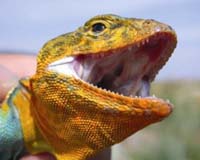
Flagstaff AZ (SPX) Jun 27, 2006 Working at the Wichita Mountains National Wildlife Refuge in Oklahoma, researchers have shown that when an adult male lizard gapes his jaws at a rival male during an intense territorial interaction, information is made available to his opponent about how hard he can bite - indeed, the lizard's jaw muscles become clearly visible. Further, some lizards have evolved bright patches that reflect ultraviolet light, which lizards can see, to delineate the jaw muscles. In a paper from the July issue of The American Naturalist, Kristopher Lappin (Northern Arizona University), Yoni Brandt (University of Toronto), Jerry Husak (Oklahoma State University), Joe Macedonia (Arizona State University), and Darrell Kemp (James Cook University), demonstrate that a threat display can provide accurate information about the performance of a weapon. Lappin and colleagues point out that the information about bite force provided by the display does not correspond to body or head size because males of similar size can vary substantially in how hard they can bite. The display thus provides unique and honest information about weapon quality, as well as a mechanism for making the decision to fight or to back down. Adult male collared lizards (the species examined in this study) are larger than the females, have hypertrophied jaw muscles, and are highly territorial toward other males. All of this relates to males having evolved the ability to bite with great force, which means that they can seriously wound rivals in fights. "When you've seen what these lizards can do to each other with their jaws, inflicting deep lacerations and even breaking bones, it makes sense that avoiding fights would be advantageous, even if you are likely to win," Lappin says. When two competing males engage in a gaping display, each shows off its weapon while simultaneously affording an opportunity to evaluate its rival's weapon. In animals from insects to humans, such displays likely play an important role in assessing the risks associated with fighting, as well as in reinforcing the experiences of past fights with specific individuals. "You see the same with humans," Lappin explains. "Think back to the rivalries of adolescence. Fights took place in order to establish dominance relationships in the neighborhood, but the fights themselves were rare. Most of it was posturing and showing off, displays per se, that served to advertise physical prowess as well as to reinforce the consequences of previous confrontations." Community Email This Article Comment On This Article Related Links Northern Arizona University University of Toronto Oklahoma State University Arizona State University James Cook University Darwin Today At TerraDaily.com
 Development Key To Promoting Primate Conservation In Uganda
 Entebbe, Uganda (AFP) Jun 26, 2006
Human development is the only way to promote the sustainable conservation of wildlife, including Africa's endangered Great Apes, in impoverished nations, Uganda's president said Monday. |
|
|

| The content herein, unless otherwise known to be public domain, are Copyright 1995-2006 - SpaceDaily.AFP and UPI Wire Stories are copyright Agence France-Presse and United Press International. ESA PortalReports are copyright European Space Agency. All NASA sourced material is public domain. Additionalcopyrights may apply in whole or part to other bona fide parties. Advertising does not imply endorsement,agreement or approval of any opinions, statements or information provided by SpaceDaily on any Web page published or hosted by SpaceDaily. Privacy Statement |