|
 |
 |
 |
 |
 |
 |
 |
 |

 |
Scientists Suggest Solution To 30-Year-Old Martian Mystery
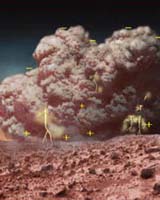
Greenbelt, MD (SPX) Aug 04, 2006 Electricity generated in dust storms on Mars may produce reactive chemicals that build up in the Martian soil, according to NASA-funded research. The chemicals, like hydrogen peroxide (H2O2), may have caused the contradictory results when NASA's Viking landers tested the Martian soil for signs of life, according to the researchers. Lead authors Gregory Delory, senior fellow at the University of California Berkeley Space Sciences Laboratory, and Sushil Atreya, planetary science professor at the University of Michigan, Ann Arbor, reported their results in a tandem set of papers in the June 2006 issue of the journal "Astrobiology". Dust particles become electrified in Martian dust storms when they rub against each other as they are carried by the winds, transferring positive and negative electric charge in the same way you build up static electricity if you shuffle across a carpet. "From our field work, we know that strong electric fields are generated by dust storms on Earth," said co-author William Farrell of NASA's Goddard Space Flight Center, Greenbelt, Md. "Also, laboratory experiments and theoretical studies indicate that conditions in the Martian atmosphere should produce strong electric fields during dust storms there as well." Delory's team calculated that electric fields generated by the swirling dust are strong enough to break apart carbon dioxide and water molecules in the Martian atmosphere. "Our calculations indicate that once these electric fields are produced by dust storms on Mars, they free more electrons from atoms and molecules in the thin Martian atmosphere. These electrons then collide with and break apart molecules such as water and carbon dioxide, creating new chemical products that continue to react with other constituents in Mars' atmosphere," said Delory. Atreya's team then identified the various ways the broken molecules recombine into reactive chemicals like hydrogen peroxide and ozone (O3), and calculated the amounts that might accumulate in the Martian soil over time. "Once carbon dioxide and water are broken apart, the resulting products interact with the other molecules in the Martian atmosphere to produce large quantities of the highly-reactive hydrogen peroxide. In fact hydrogen peroxide produced by dust electrification can greatly exceed the rate that it is produced by the conventional energy source of ultraviolet radiation from the sun, so much so that hydrogen peroxide would snow out of the atmosphere and permeate the Martian soil," said Atreya. In 1976, the twin Viking landers scooped up Martian soil and added nutrients mixed with water to it. If microscopic life were present, the nutrients would be used up and waste products would be released. Three different experiments involved in this test gave conflicting results. The Labeled Release and the Gas Exchange experiments indicated something active was in the soil, because the nutrients were broken down. However, the Mass Spectrometer experiment did not find any organic matter in the soil. In 1977, Viking researchers suggested that the apparent contradiction could be explained if a very reactive nonorganic substance that imitated the activity of life by breaking down the nutrients was embedded in the soil. Hydrogen peroxide and ozone were considered possible candidate reactive compounds. While ultraviolet radiation from the sun could produce a certain amount of reactive chemicals in the atmosphere, there were no physical processes known to explain how large amounts of such reactive material could accumulate in the Martian soil. Some researchers at the time considered the possibility that dust storms might be electrically active in a way similar to terrestrial thunderstorms, and that these storms might be a source of the new reactive chemistry. This dust storm suggestion remained dormant for close to 30 years. The Astrobiology papers now provide detailed analysis to support this theory, based on results from field and laboratory studies by the team over the past five years. The theory could be tested further by an electric field sensor working in tandem with an atmospheric chemistry system on a future Mars rover or lander, according to the teams. The team includes Delory, Atreya, Farrell, and Nilton Renno and Ah-San Wong, (University of Michigan), Steven Cummer (Duke University, Durham, N.C.), Davis Sentman (University of Alaska), John Marshall (SETI Inst., Mountain View, Calif.), Scot Rafkin (Southwest Research Institute, San Antonio, Texas) and David Catling (University of Washington). The research was funded by NASA's Mars Fundamental Research Program and NASA Goddard internal institutional funds. Community Email This Article Comment On This Article Related Links Mars News and Information at MarsDaily.com Mars News and Information at MarsDaily.com Lunar Dreams and more
 Cleaning Event Boosts Power On Opportunity
 Pasadena CA (SPX) Aug 02, 2006
With only eight Martian days to go before Opportunity joins its twin Spirit in 900-sol territory, the rover has spent its last five sols at a target called Joseph McCoy. |
|
|

| The content herein, unless otherwise known to be public domain, are Copyright 1995-2006 - SpaceDaily.AFP and UPI Wire Stories are copyright Agence France-Presse and United Press International. ESA PortalReports are copyright European Space Agency. All NASA sourced material is public domain. Additionalcopyrights may apply in whole or part to other bona fide parties. Advertising does not imply endorsement,agreement or approval of any opinions, statements or information provided by SpaceDaily on any Web page published or hosted by SpaceDaily. Privacy Statement |