|
 |
 |
 |
 |
 |
 |
 |
 |

 |
Scientists Discover New Ring And Other Features At Saturn
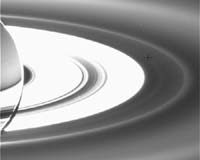
Boulder CO (SPX) Sep 20, 2006 Saturn sports a new ring in an image taken by NASA's Cassini spacecraft on Sunday, Sept. 17, during a one-of-a-kind observation. Other spectacular sights captured by Cassini's cameras include wispy fingers of icy material stretching out tens of thousands of kilometers from the active moon, Enceladus, and a cameo color appearance by planet Earth. The images were obtained during the longest solar occultation of Cassini's four-year mission. During a solar occultation, the sun passes directly behind Saturn, and Cassini lies in the shadow of Saturn while the rings are brilliantly backlit. Usually, an occultation lasts only about an hour, but this time it was a 12-hour marathon. Sunday's occultation allowed Cassini to map the presence of microscopic particles that are not normally visible across the ring system. As a result, Cassini saw the entire inner Saturnian system in a new light. The new ring is a tenuous feature, visible outside the brighter main rings of Saturn and inside the G and E rings, and coincides with the orbits of Saturn's moons Janus and Epimetheus. Scientists expected that meteoroid impacts on Janus and Epimetheus might kick particles off the moons' surfaces and inject them into Saturn orbit, but they were surprised that a well-defined ring structure exists at this location. Saturn's extensive, diffuse E ring, the outermost ring, had previously been imaged one small section at a time. The 12-hour marathon enabled scientists to see the entire structure in one view. The moon Enceladus is seen sweeping through the E ring, extending wispy, fingerlike projections into the ring. These very likely consist of tiny ice particles being ejected from Enceladus' south polar geysers, and entering the E-ring. "Both the new ring and the unexpected structures in the E ring should provide us with important insights into how moons can both release small particles and sculpt their local environments,"said Matt Hedman, a research associate working with team member Joseph Burns, an expert in diffuse rings, at Cornell University in Ithaca, N.Y. In the latest observations, scientists once again see the bright ghost-like spokes - - transient, dusty, radial structures -- streaking across the middle of Saturn's main rings. Capping off the new batch of observations, Cassini cast its powerful eyes in our direction and captured Earth, a pale blue orb, and a faint suggestion of our moon. Not since NASA's Voyager 1 spacecraft saw Earth as a pale blue dot from beyond the orbit of Neptune has Earth been imaged in color from the outer solar system. "Nothing has greater power to alter our perspective of ourselves and our place in the cosmos than these images of Earth we collect from faraway places like Saturn," said Carolyn Porco, Cassini imaging team leader at the Space Science Institute, Boulder, Colo. Porco was one of the Voyager imaging scientists involved in taking the Voyager 'Pale Blue Dot' image. "In the end, the ever-widening view of our own little planet against the immensity of space is perhaps the greatest legacy of all our interplanetary travels." In the coming weeks, several science teams will analyze data collected by Cassini's other instruments during this rare occultation event. The data will help scientists better understand the relationship between the rings and moons, and will give mission planners a clearer picture of ring hazards to avoid during future ring crossings. Community Email This Article Comment On This Article Related Links Cassini at JPL Cassini images Explore The Ring World of Saturn and her moons Explore The Ring World of Saturn and her moons Jupiter and its Moons The million outer planets of a star called Sol News Flash at Mercury
 Rings of Saturn To Shine As Never Seen Before
 Pasadena CA (SPX) Sep 18, 2006
Ring scientists have been waiting for this. Finally, after more than two years orbiting Saturn, the Cassini spacecraft reaches one of the ultimate vantage points. The rings should shine with majesty worthy of the "Jewel of the Solar System." |
|
|

| The content herein, unless otherwise known to be public domain, are Copyright 1995-2006 - SpaceDaily.AFP and UPI Wire Stories are copyright Agence France-Presse and United Press International. ESA PortalReports are copyright European Space Agency. All NASA sourced material is public domain. Additionalcopyrights may apply in whole or part to other bona fide parties. Advertising does not imply endorsement,agreement or approval of any opinions, statements or information provided by SpaceDaily on any Web page published or hosted by SpaceDaily. Privacy Statement |