|
 |
 |
 |
 |
 |
 |
 |
 |

 |
Rings of Saturn To Shine As Never Seen Before
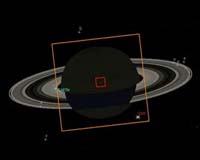
Pasadena CA (SPX) Sep 18, 2006 Ring scientists have been waiting for this. Finally, after more than two years orbiting Saturn, the Cassini spacecraft reaches one of the ultimate vantage points. The rings should shine with majesty worthy of the "Jewel of the Solar System." The event is a solar occultation -- when the sun passes directly behind the planet as Cassini looks on. And this is not just any solar occultation; it's a very long one. The Cassini spacecraft will be right where scientists studying the rings want it: far enough from Saturn to be able to image it all and, more importantly, with the Sun blocked by the planet for 12 hours, long enough to properly map the elusive microscopic particles moving within the extended ring system. Data collected during this observation might also uncover clues about Enceladus' past behavior and aid mission planners in refining ring hazard models for future ring crossings. Thanks to the slow occultation, images taken during this carefully designed orbit may also uncover new ring structures and, at the very least, capture truly spectacular views of the D, F, G and E rings. "We are all sort of on pins and needles waiting for the results," says Brad Wallis, Cassini Rings Discipline Scientist. "When you get these kinds of high phase angles, very small particles almost focus the light right at the observer. So these faint rings that are so hard to see are going to be considerably brighter and show us details that are just not possible to see in other viewing conditions. All the space between Enceladus and the G ring is probably going to be pretty well lit up. It's really a unique event." While solar occultations in the mission typically last only an hour, this time it will last almost 12 hours, truly a dream come true considering it takes about 30 minutes to turn the spacecraft to the proper position. During "regular" occultations, scientists can only take a few images before the Sun reappears and the spacecraft has to be turned away to avoid damaging its sensitive instruments. "So far we have only had some tiny snapshots of the E ring at high phase angles," Wallis says. "In this case we can basically image the entire ring. During that period of time, we can image all of the rings from the outer E ring inward at very high phase angles, which means that we are almost looking straight into the sun, but the sun is behind Saturn." Besides mapping the E ring, the observation will allow scientists to learn if there are structures within the ring. Structure within the E ring would be a good indication that Enceladus is not spewing material out at a regular pace. "We know that the E ring is a large, diffuse cloud going out from a little beyond the G ring to far beyond Enceladus," Wallis says. "Enceladus seems to be the source of it, given the ice jets Cassini has recently discovered, so if the whole ring looks uniform, that means Enceladus has being spewing stuff at the same rate for quite a long time. But if there are clumps and/or ringlets in it that we can not explain, it means the spew rate out of Enceladus changes. This is the one chance we have to see a snapshot of the history of Enceladus." The E ring is a very large cloud of dust made up of extremely fine particles -- 1 or 2 microns -- more or less the size of smoke particles. It stretches from 150,000 to 240,000 kilometers (93,000 to 149,000 miles) from the center of Saturn and is about 5,000 to 10,000 kilometers (3,100 to 6,200 miles) thick. Crossing the E ring, however, poses no hazard to the spacecraft. "We pass through the E ring all the time, and we get samples of particles every time we cross it, but we have only a rough idea of what the structure looks like in detail because the difference between detecting three particles or four particles at any ring plane crossing is insignificant," Wallis explains. "This is the only chance we get to point the cameras right at the Sun and see these things in this very forward scattered mode." The same technique worked in the past, and it allowed mission planners to avoid cross the rings safely. "NASA's Voyager 2 discovered a vast and complex new system of ringlets around Uranus this way, using only one single image taken in several minutes. We'll have 10 straight hours," Wallis says. Cassini is slated to send home the images starting on Sept. 17. To better exploit the rare opportunity, Cassini will take images in multiple exposures and colors. The Imaging Science Subsystem and Visible and Infrared Mapping Spectrometer will be the prime instruments in this set of unique observations. "The imaging team will use the wide-angle camera to do a mosaic of the entire area in multiple colors and multiple exposures because the brightness of the particles changes very steeply when you move into these high-phase angle areas. The team will also use the narrow-angle camera to get some high resolution looks at selected areas." Wallis says. "We have looked at these rings at 140 degrees, and at 150 degrees. During this opportunity we will see some parts of the rings at phase angles up to 179.4 degrees." "Because this is somewhat uncharted territory (viewing these faint rings at these very high phase angles), and because we only have one opportunity like this in the entire 4-year mission, the teams planning this science want to be sure they get it and get it right," adds Wallis. Community Email This Article Comment On This Article Related Links Explore The Ring World of Saturn and her moons Explore The Ring World of Saturn and her moons Jupiter and its Moons The million outer planets of a star called Sol News Flash at Mercury
 Enceladus Exhales Water Ice Into Saturn Orbit
 Pasadena CA (SPX) Sep 06, 2006
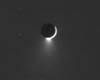
Enceladus continues to exhale water ice into Saturn orbit, keeping the E ring topped off with tiny particles. Enceladus (505 kilometers, or 314 miles across) is a source of much interest for planetary scientists, being nearly seven times smaller than Earth's own moon, yet having active geology that appears to involve near-surface liquid water. |
|
|

| The content herein, unless otherwise known to be public domain, are Copyright 1995-2006 - SpaceDaily.AFP and UPI Wire Stories are copyright Agence France-Presse and United Press International. ESA PortalReports are copyright European Space Agency. All NASA sourced material is public domain. Additionalcopyrights may apply in whole or part to other bona fide parties. Advertising does not imply endorsement,agreement or approval of any opinions, statements or information provided by SpaceDaily on any Web page published or hosted by SpaceDaily. Privacy Statement |