|
 |
 |
 |
 |
 |
 |
 |
 |

 |
SPACEHAB Announces Successful ARCTUS Mid-Air Recovery Test
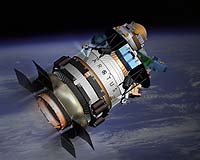
Houston TX (SPX) Dec 20, 2007 SPACEHAB has announced the success of a mid air retrieval demonstration test performed with applications to its Advanced Research and Conventional Technology Utilization Spacecraft (ARCTUS) Program. The Company is releasing video of the successful test on SPACEHAB's ARCTUS Program website. The test, performed by Vertigo Incorporated and United Launch Alliance (ULA), was designed to demonstrate the feasibility of mid-air capture for a variety of applications. The mass simulator was carried by helicopter to an altitude of 5,000 feet and then released under a parafoil. The helicopter was then able to capture a drag line being trailed behind the chute, lift the combined mass, collapse the parafoil, and gently place the simulated spacecraft on the ground. By contrast, the Russian Soyuz spacecraft makes a relatively hard landing on solid ground. The ARCTUS Program will support NASA's requirement to fill the International Space Station (ISS) cargo supply gap between the space shuttle's planned retirement in 2010 and the replacement Orion program scheduled to be operational in 2015. ARCTUS will also provide SPACEHAB with an additional means of space access in support of the Company's previously announced SPACEHAB Microgravity Sciences initiatives which include returning to Earth valuable and often fragile biotech products that require the soft landing afforded by the mid air capture retrieval technique. "All of the pieces are coming together very nicely in our pursuit of providing the ideal environment to process biotech products in microgravity," said SPACEHAB, Inc. Chief Executive Officer Thomas B. Pickens, III. "The mid air capture will ensure that all of the cost and care invested to send valuable samples to space will result in the maximum yield when safely returned to Earth," he said. "We are very pleased with our working relationship with ULA and look forward to achieving many successful milestones together to reach the ultimate goal of flying ARCTUS to low Earth orbit in 2010. This is a very exciting time for the space industry," he concluded. Video from the mid air retrieval can be accessed at the official ARCTUS program website. Community Email This Article Comment On This Article Related Links ARCTUS Program website Space Tourism, Space Transport and Space Exploration News
 Final Preparations For First Human-Rated Spacecraft To Be Launched From Europe's Spaceport
 Kourou, French Guiana (ESA) Dec 19, 2007
For the first time in 40 years of space activities, a silent revolution is taking place at the European launch site in Kourou. Jules Vernes, the first human-rated spacecraft to be launched from Europe's Spaceport, is being prepared for launch. The 48 m3 pressurised module of the largest, most complex automated spacecraft ever developed in Europe has been inspected and closed, fulfilling the most stringent rules of human spaceflight. |
|
|

| The content herein, unless otherwise known to be public domain, are Copyright 1995-2007 - SpaceDaily.AFP and UPI Wire Stories are copyright Agence France-Presse and United Press International. ESA Portal Reports are copyright European Space Agency. All NASA sourced material is public domain. Additional copyrights may apply in whole or part to other bona fide parties. Advertising does not imply endorsement,agreement or approval of any opinions, statements or information provided by SpaceDaily on any Web page published or hosted by SpaceDaily. Privacy Statement |