|
 |
 |
 |
 |
 |
 |
 |
 |

 |
Russia Will Develop Space Elevators - Part 2
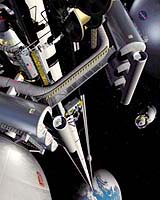
Moscow, Russia (RIA Novosti) Dec 04, 2006 In the last few years, the Space Research Institute has studied the possibility of building a space-elevator cluster that would deliver payloads from the Earth to the Moon and back. Theoretical studies and experiments showed that the cluster should comprise two cableway systems, one in a low circular and the other in a low elliptical Earth orbit, and one cableway in a circular equatorial lunar orbit. The dimensions of all three cableways should create different gravitational potentials at each end. By adjusting tether length, it will be possible to change each orbital system's angular speed of rotation. The space-elevator cluster will exchange payloads between orbital cableways. In essence, two-way freight traffic would turn such cableways into a transportation artery. Most importantly, the system's components would exchange mass and energy. For example, a system in a low circular orbit would act as a sling and place a payload into a higher elliptical orbit, where it would be captured by another cableway. The lower "sling" would then lose part of its energy and move to a lower orbit. The same would happen when a payload is transferred from a high elliptical orbit to a near-Earth cableway. The space elevator will thus deliver equipment to the Moon and bring back lunar rock and soil. Its launch frequency, the main criterion of its cost-effective performance, depends on the time needed to restore the "launching" cableway's initial altitude. The required cable length and rotational speed around the center of gravity will ensure identical trajectories when transferring a payload between lower and upper cableways at predetermined intervals. Reliable grips are needed to prevent dangling during rapid relative movements of payloads and the sling itself. With this in mind, scientists have suggested an optimal cable-inclination angle in relation to the sling's vertical movement at the link-up point. The payload and the sling grip will therefore remain near each other for considerably longer periods of time. The Space Research Institute has already conducted several experiments in water and confirmed the main parameters of the projected Earth-Moon-Earth transport system. Calculations show that the new system will weigh 28 times less than the payload it will deliver to the Moon during its entire service life. Meanwhile, the fuel burned by conventional rocket engines would weigh 16 times more than their payload. The need to exploit the Moon and Mars will serve as the main incentive for developing space elevators as mankind looks for new places to settle. Yury Zaitsev is expert at the Space Research Institute, Russian Academy of Sciences
Source: RIA Novosti Community Email This Article Comment On This Article Related Links Space Research Institute All about the technology of space and more Space Tourism, Space Transport and Space Exploration News
 Out-Of-This-World Cuisine
 Paris, France (ESA) Dec 04, 2006
Astronauts aboard the International Space Station (ISS) have been feasting on experimental gourmet food designed by top French chef Alain Ducasse, the European Space Agency (ESA) reported Friday. |
|
|

| The content herein, unless otherwise known to be public domain, are Copyright 1995-2006 - SpaceDaily.AFP and UPI Wire Stories are copyright Agence France-Presse and United Press International. ESA PortalReports are copyright European Space Agency. All NASA sourced material is public domain. Additionalcopyrights may apply in whole or part to other bona fide parties. Advertising does not imply endorsement,agreement or approval of any opinions, statements or information provided by SpaceDaily on any Web page published or hosted by SpaceDaily. Privacy Statement |