|
 |
 |
 |
 |
 |
 |
 |
 |

 |
Russia Will Develop Space Elevators
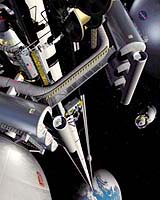
Moscow, Russia (RIA Novosti) Dec 01, 2006 Nikolai Sevastyanov, president of the Energia Rocket and Space Corporation, said Russia will build the first permanent lunar base in 2015. NASA managers claim that U.S. astronauts will land on the Moon in 2018 and manned lunar bases will subsequently be established. Chinese scientists are also spotlighting their intention to exploit the Moon's natural resources. However, delivering payloads from the Earth to the Moon and back is a major problem hindering the Moon's colonization. The same can be said about future manned missions to Mars. Chemical-propellant launch vehicles with hydrogen-oxygen engines will not prove effective in this case. For instance, the Proton rocket, with a 650-metric-ton lift-off weight, orbits 22-metric-ton spacecraft and can also launch 6.5-metric-ton interplanetary probes (that is 1% of the lift-off weight). Preliminary estimates show that a Martian mission would involve a 600-metric-ton spacecraft, which cannot lift off from the Earth. Consequently, its components must be assembled in outer space. But it would take 100 Proton rockets with a total lift-off weight of 65,000 metric tons to orbit all spacecraft elements. Nor can Russia's heavier Angara space system provide the solution. The U.S. Apollo Moon program, which relied heavily on Saturn V launch vehicles in the 1960s, proved a dead-end option because one Saturn V rocket costs $2 billion to operate. Moreover, the United States will spend an estimated $10 billion on a new heavy-duty launch vehicle featuring Space Shuttle components and due to cost the same $2 billion per launch. As for the unique Soviet-made super heavy Energia launch vehicle, the last word in rocket technology, it can orbit 105-metric-ton payloads, or 4.3% of its lift-off weight. Energia rockets with a total lift-off weight of 50,000 metric tons would therefore be needed to launch all elements of the Martian spacecraft. Finally, modern chemical-propellant rocket engines are about to reach the limit of their performance capabilities. Experts are now contemplating electric rocket engines with an enhanced specific thrust (the ratio between a rocket engine's thrust and working-medium flow per second) of between 1,200 and 1,400 seconds for interplanetary flights, which is 5-10 times more than liquid rocket engines. But a spacecraft with electric rocket engines would take much longer to reach its destination because it could not attain an optimal boost trajectory. Scientists from the Space Research Institute of the Russian Academy of Sciences have developed a unique space elevator for lunar and Martian missions. Although a bit slower, the new system will cut back on interplanetary delivery expenses. A space elevator consists of satellites, spacecraft and payloads linked by long, thin, flexible elements. The simplest system links two spacecraft by means of a cable with a length of several dozen or even several hundred kilometers. This tandem, which resembles a space sling, revolves around its center of gravity, which in turn has a predetermined orbit. Either of the two spacecraft can therefore launch a payload along any required trajectory without any rocket engines. The foundations of the space-elevator theory were laid by Russian scientists. Konstantin Tsiolkovsky, the father of astronautics, suggested using a space-tether system to create artificial gravity aboard orbital stations. Fridrikh Tsander, an early Russian space visionary, advocated placing a space elevator with a 60,000-km tether on the Moon. He believed that gravitational and centrifugal forces would stretch the tether and allow it to be used as a cableway to transport payloads. In 1965, the Central Machine-Building Design Bureau, headed by leading rocket scientist Sergei Korolev, a member of the Soviet Academy of Sciences, started preparing for the first space-tether experiment. The Bureau, which later changed its name to Energia Rocket and Space Corporation, planned to link a Soyuz spacecraft to the last stage of the launch vehicle using a steel cable. Unfortunately, this project was mothballed after Korolev's death and resumed by Energia only 20 years later. Several space-elevator experiments were conducted as part of U.S., Italian-U.S. and U.S.-Japanese projects. Not all of them were successful; nonetheless, experts managed to accomplish some of their objectives. the continuation of the article will be posted soon
Source: RIA Novosti Community Email This Article Comment On This Article Related Links Energia Rocket and Space Corporation Travelling through Space Space Tourism, Space Transport and Space Exploration News
 Russia To Sign Contract To Launch South Korean Astronaut Into Space
 Moscow, Russia (RIA Novosti) Nov 30, 2006
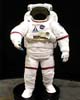
Russia will sign a contract with South Korea December 7 to launch the East Asian country's first astronaut on board a Russian carrier rocket in 2008, the Federal Space Agency said Wednesday. The number of hopefuls to become South Korea's first ever astronaut has dropped from 36,000 to 30. The final candidate and one reserve will be selected soon. |
|
|

| The content herein, unless otherwise known to be public domain, are Copyright 1995-2006 - SpaceDaily.AFP and UPI Wire Stories are copyright Agence France-Presse and United Press International. ESA PortalReports are copyright European Space Agency. All NASA sourced material is public domain. Additionalcopyrights may apply in whole or part to other bona fide parties. Advertising does not imply endorsement,agreement or approval of any opinions, statements or information provided by SpaceDaily on any Web page published or hosted by SpaceDaily. Privacy Statement |