|
 |
 |
 |
 |
 |
 |
 |
 |

 |
Runoff On Early Mars Identified In River Channels By Geologists
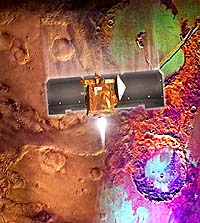
Washington DC (SPX) May 25, 2005 Mars is now a cold, dry desert, but robotic satellites and rovers have returned new evidence of a warmer and wetter climate more than 3.5 billion years ago, when conditions may have been more favorable for life. Geologists at the Smithsonian National Air and Space Museum's Center for Earth and Planetary Studies, working with colleagues at the University of Virginia, have discovered 21 river channels in the dry Martian valleys, which provide new clues to this ancient climate. The researchers have determined that Martian rivers were about the same size as their counterparts on Earth, suggesting similar amounts of runoff from thunderstorms or rapid snowmelt. The findings will appear in the June issue of the journal Geology. Until the discovery of channels, scientists could not determine the amount of water that had flowed through these valleys. As lead author Ross Irwin, museum geologist, explained, "We have thought for some time that it likely rained or snowed on early Mars, but until we found the river channels we had no idea whether we were dealing with drizzle or storms." Co-authors Robert Craddock, another National Air and Space Museum geologist, and Alan Howard of the University of Virginia made a detailed "Case for Rainfall on a Warm, Wet Early Mars" in a 2002 paper. Larger, periodic floods carve wider river channels, so by measuring the width of a channel, geologists can estimate the size of the flood that carved it. To explain the width of the Martian channels, some watersheds likely received an inch or more of rain per day during storms, or more than 10 inches of melted snow on particularly warm days. Larger watersheds gave rise to larger river channels, as they do on Earth. Even using a conservative method to estimate the amount of water discharged through the rivers, the Martian rivers still matched their terrestrial counterparts in terms of the volume of water per second during these ancient episodes of flow. Previously, only eight river channels had been found in Martian valleys, two of these by Irwin and Howard in 2002. The new discoveries were made using the THEMIS camera on the Mars Odyssey spacecraft that is currently in orbit around Mars. During the 3.5 billion years since water flowed in these channels, the valley floors have become partly filled by wind-blown sand and debris from meteorite impacts, so the channels are exposed along only part of their floors. The Martian river channels do not appear to have been active nearly as long as terrestrial rivers have however. "If it rained this hard every day throughout the many millions of years that runoff occurred, Mars would be far more heavily eroded than it is," Irwin said. "It seems more likely that Mars was wet at times with drier intervals in between." Mars may have always been a desert, but like the desert in the western United States, water appears to have flowed abundantly at least part of the time. Community Email This Article Comment On This Article Related Links National Air and Space Museum University of Virginia Center for Earth and Planetary Studies SpaceDaily Search SpaceDaily Subscribe To SpaceDaily Express Mars News and Information at MarsDaily.com Lunar Dreams and more
 Spirit Heading To 'Home Plate'
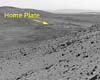 Pasadena CA (JPL) Jan 09, 2006
Last week Spirit completed robotic-arm work on "El Dorado." The rover used all three of its spectrometers plus the microscopic imager for readings over the New Year's weekend. |
|
|

| The content herein, unless otherwise known to be public domain, are Copyright 1995-2006 - SpaceDaily.AFP and UPI Wire Stories are copyright Agence France-Presse and United Press International. ESA PortalReports are copyright European Space Agency. All NASA sourced material is public domain. Additionalcopyrights may apply in whole or part to other bona fide parties. Advertising does not imply endorsement,agreement or approval of any opinions, statements or information provided by SpaceDaily on any Web page published or hosted by SpaceDaily. Privacy Statement |