|
 |
 |
 |
 |
 |
 |
 |
 |

 |
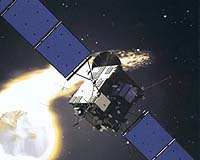
Rosetta Healthy And On Target For February Mars Flyby
Paris, France (ESA) Nov 21, 2006 The Rosetta spacecraft and its payload are in excellent health and everything is set to prepare the Mars flyby on 25 February 2007. On 26 July the Rosetta spacecraft came out of the two-month Near Sun Hibernation Mode (NSHM). The spacecraft performance during that period was nominal. Subsequently it was reconfigured to Active Cruise Mode. Rosetta is back to two ground station passes per week, which are used for telemetry recovery and S/C maintenance operations.
Operations and Archiving Before entering the NSHM the Solar Conjunction activities were completed on 18 May 2006, though TM/TC link was actually never permanently lost. This phase included the RSI solar corona sounding campaign from 15 March until 18 May. During NSHM RPC, the Rosetta Plasma Consortium carried out a measurement campaign in the (far) downstream tail region of comet Honda between 4 and 9 July 2006. Preliminary analysis of the data, which was presented by the team during the 21st Rosetta Science Working Team Meeting (SWTM) at ESOC, 14/15 September, indicates that the Magnetometer detected the tail. The observations are so promising that similar campaigns have been requested for future potential comet tail crossings. As usual, the Standard Radiation Monitor (SREM) has been the only payload element operated continuously and is active in background mode with accumulation parameters configured for active cruise. The first summary results from the SREM covering the first two years of the mission were presented at the last SWTM. A Payload Passive Check-out was conducted 19-25 August and preparations have been completed for the Active Payload Check-out that will be performed from 27 November until 21 December 2006. The next big event for Rosetta will be the Mars flyby on 25 February 2007 with the closest approach at 01:53 UTC. In preparation for this crucial mission milestone the DSN/ESA Tracking Campaign already started on 28 August. Before that two DSN delta-DOR tracks of 1-hour each were performed (DSS 24/45 and DSS 55/25) beginning of August. This was the first time that delta-DOR measurements were taken with Rosetta. The data processing performed by Flight Dynamics that the reduced delta-DOR data were of excellent quality. Before the actual Mars flyby, OSIRIS will observe Lutetia, the mission's second asteroid target in January and in April Rosetta will support a joint Jupiter observation campaign in support of NASA's New Horizon mission to Pluto. Community Email This Article Comment On This Article Related Links Rosetta spacecraft Mars News and Information at MarsDaily.com Mars News and Information at MarsDaily.com Lunar Dreams and more
 NASA's Newest Mars Orbiter Passes Communications Relay Test
 Pasadena CA (JPL) Nov 19, 2006
An orbiting NASA spacecraft just starting to study Mars with six science instruments has successfully tested another key part of its payload, a versatile radio for relaying communications with robots on the surface of Mars. During its first relay test since reaching Mars in March, the Mars Reconnaissance Orbiter used this radio payload, called Electra, in a two-way link with NASA's Mars Exploration Rover Spirit. |
|
|

| The content herein, unless otherwise known to be public domain, are Copyright 1995-2006 - SpaceDaily.AFP and UPI Wire Stories are copyright Agence France-Presse and United Press International. ESA PortalReports are copyright European Space Agency. All NASA sourced material is public domain. Additionalcopyrights may apply in whole or part to other bona fide parties. Advertising does not imply endorsement,agreement or approval of any opinions, statements or information provided by SpaceDaily on any Web page published or hosted by SpaceDaily. Privacy Statement |