|
 |
 |
 |
 |
 |
 |
 |
 |

 |
NASA's Newest Mars Orbiter Passes Communications Relay Test
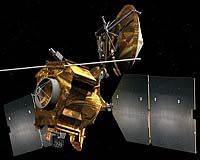
Pasadena CA (JPL) Nov 19, 2006 An orbiting NASA spacecraft just starting to study Mars with six science instruments has successfully tested another key part of its payload, a versatile radio for relaying communications with robots on the surface of Mars. During its first relay test since reaching Mars in March, the Mars Reconnaissance Orbiter used this radio payload, called Electra, in a two-way link with NASA's Mars Exploration Rover Spirit. The orbiter has dual roles as a science mission and a telecommunications satellite. It will support communications between Earth and future Mars surface missions, such as the 2007 Phoenix Mars Lander and 2009 Mars Science Laboratory. "The successful test establishes Mars Reconnaissance Orbiter as a key element of our Mars telecommunications infrastructure," said Chad Edwards, chief telecommunications engineer of the Mars Network Office at NASA's Jet Propulsion Laboratory, Pasadena, Calif. "With its Electra relay payload, this orbiter will play a critical role in providing robust, high-bandwidth communications links for our future landers later this decade and into the next. It will increase the science return from these missions and enhance our virtual presence on the Martian surface." JPL's Jim Graf, project manager for Mars Reconnaissance Orbiter, said, "Our primary science phase started Nov. 7, and this successful Electra test shows we're also in good shape for the following phase, the relay phase of the mission. Both phases will make good use of our orbiter's capability for sending data to Earth at up to 10 times the rate of any previous Mars mission." Using Mars orbiters as radio relays to increase data return from rovers and other landers reduces the mass and power the surface spacecraft need for communications. To build the relay network cost-effectively, NASA includes a relay communications payload on each of its science orbiters. Mars Global Surveyor, at Mars since 1997, and Mars Odyssey, there since 2001, established a relay capacity that the twin rovers Spirit and Opportunity have used extensively since their 2004 landings. More than 96 percent of the data returned from the rovers has come to Earth via energy-efficient relay through those two orbiters, at much higher data rates than the rovers can achieve on their direct links to Earth. The Electra package on Mars Reconnaissance Orbiter, like the relay radios on Global Surveyor and Odyssey, uses an ultra-high-frequency (UHF) portion of the radio spectrum. In addition to its relay function, Electra can also be used by surface missions, or by future spacecraft approaching Mars, to determine their positions with precision and to synchronize their clocks. During last week's tests, Electra initiated a relay session by hailing the Spirit rover. Spirit responded with its own relay radio, and the two spacecraft established a link at 8 kilobits per second on the forward link from Mars Reconnaissance Orbiter to Spirit and 128 kilobits per second from Spirit back to the orbiter. Both radios used a communications standard called the Proximity-1 Space Link Protocol, established by the international Consultative Committee for Space Data Systems for ensuring compatible and gap-free communications on such relay links. During the four-minute session, the orbiter delivered five commands to the rover, and the rover sent up 30 megabits of information, which the orbiter subsequently transmitted to Earth for delivery to the rover's operations team at JPL. Nearly all of the signal-processing capabilities of Electra can be reprogrammed in flight, giving it more flexibility than earlier spacecraft relay radios. "Electra is NASA's first software-defined radio sent to deep space," said JPL's Tom Jedrey, manager for the Electra payload. "From the ground, we can change the fundamentals of its signal processing whenever that is helpful. This means it will be able to accommodate new communication protocols and signal-processing methods over the course of the Mars Reconnaissance Orbiter's operational life." Community Email This Article Comment On This Article Related Links Mars Reconnaissance Orbiter Mars News and Information at MarsDaily.com Mars News and Information at MarsDaily.com Lunar Dreams and more
 NASA's Red Planet 'Photographer' Jim Bell Presents 'Postcards From Mars'
 Ithaca NY (SPX) Nov 17, 2006
On Earth, Cornell astronomer Jim Bell says, he is an amateur photographer at best. But "I've always been drawn to landscapes," he says. That's a good thing. These days he finds himself accumulating a lot of them: 160,000, actually, taken by two tireless faraway helpers called Spirit and Opportunity over the last two-and-a-half years. |
|
|

| The content herein, unless otherwise known to be public domain, are Copyright 1995-2006 - SpaceDaily.AFP and UPI Wire Stories are copyright Agence France-Presse and United Press International. ESA PortalReports are copyright European Space Agency. All NASA sourced material is public domain. Additionalcopyrights may apply in whole or part to other bona fide parties. Advertising does not imply endorsement,agreement or approval of any opinions, statements or information provided by SpaceDaily on any Web page published or hosted by SpaceDaily. Privacy Statement |