|
 |
 |
 |
 |
 |
 |
 |
 |

 |
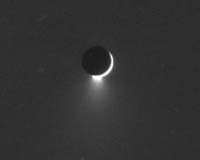
Enceladus Exhales Water Ice Into Saturn Orbit
Pasadena CA (SPX) Sep 06, 2006 Enceladus continues to exhale water ice into Saturn orbit, keeping the E ring topped off with tiny particles. Enceladus (505 kilometers, or 314 miles across) is a source of much interest for planetary scientists, being nearly seven times smaller than Earth's own moon, yet having active geology that appears to involve near-surface liquid water. The image was taken in visible green light with the Cassini spacecraft narrow-angle camera on Aug. 11, 2006 at a distance of approximately 2.2 million kilometers (1.3 million miles) from Enceladus and at a Sun-Enceladus-spacecraft, or phase, angle of 164 degrees. Image scale is 13 kilometers (8 miles) per pixel. Community Email This Article Comment On This Article Related Links Cassini at JPL Cassini images Explore The Ring World of Saturn and her moons Explore The Ring World of Saturn and her moons Jupiter and its Moons The million outer planets of a star called Sol News Flash at Mercury
 Saturn's Methane Moon
 Moffett Field CA (SPX) Sep 04, 2006
Saturn's moon Titan seems to have little in common with Earth. At just 93 Kelvin, the giant moon is beyond ice cold, and its atmosphere is dominated by methane rather than nitrogen and oxygen. But in July, radar on NASA-ESA's Cassini-Huygens mission found a landscape with a striking resemblance to Earth. |
|
|

| The content herein, unless otherwise known to be public domain, are Copyright 1995-2006 - SpaceDaily.AFP and UPI Wire Stories are copyright Agence France-Presse and United Press International. ESA PortalReports are copyright European Space Agency. All NASA sourced material is public domain. Additionalcopyrights may apply in whole or part to other bona fide parties. Advertising does not imply endorsement,agreement or approval of any opinions, statements or information provided by SpaceDaily on any Web page published or hosted by SpaceDaily. Privacy Statement |