|
 |
 |
 |
 |
 |
 |
 |
 |

 |
Researchers Observe Superradiance In A Free Electron Laser
Upton NY (SPX) Feb 08, 2007 At the U.S. Department of Energy's (DOE) Brookhaven National Laboratory, a team of researchers has generated extremely short light pulses using a new technique that could be used in the next generation of light source facilities around the world to catch molecules and atoms in action. Published on January 19, 2007 in Physical Review Letters, the research team's findings describe the use of a laser to control the pulse duration of light from a free electron laser (FEL), a type of light source with a brightness up to one billion times higher than that of ordinary synchrotron light. The team also reports the first experimental observation of a phenomenon called superradiance. Most of the world's light sources � facilities such as Brookhaven's National Synchrotron Light Source (NSLS) that produce x-ray, ultraviolet, and infrared light for research in fields ranging from biology to nanotechnology � produce a broad range of wavelengths, or colors of light. This is ideal for hosting a wide variety of experiments, but to understand how molecules change their structure in chemical and biological systems, scientists need extremely short pulses of light (shorter than one trillionth of a second) with short wavelengths. This is where FELs are valuable, as they can provide pulses of light that are a thousand times shorter than those produced at existing light sources and contain a million more photons per pulse. Like a strobe flash, the ultra-short FEL allows scientists to take time-resolved images of biological and chemical processes and various other atomic-scale events. "In existing light sources, we just take a static snapshot of a sample," said NSLS physicist Takahiro Watanabe, one of the paper's authors. "We get the location of the pieces, but what happens if the pieces move? You don't know how they actually got there. What you want is to take images along the way to see these things move, and that's where these ultra-fast sources come into play." Synchrotron light is produced by accelerating of a beam of electrons and sending it through a magnetic field. Generally, the pulse duration of both synchrotron and FEL light is determined by that of the electron beam. Tremendous effort has been devoted to generating short electron pulses, but scientists have been unable to shorten the electron pulse past a certain point because of forces that repel the electrons in the beam away from each other. At Brookhaven's Source Development Lab (SDL), researchers found a way to generate a very short FEL pulse that doesn't depend on the length of the electron pulse. This was done using a titanium-sapphire laser that combines a femtoseconds pulse of light with the much longer electron beam. A femtosecond is extremely fast � one billionth of one millionth of a second. This leads to a femtosecond FEL pulse that keeps growing in intensity and shortening in time duration, which is attributed to a phenomenon called superradiance. "The electron beam and the laser beam don't move at the same speed, they slip a little bit," Watanabe said. "So this scenario provides new areas on the electron beam for the interaction to continue and allows the intensity of light to keep growing." Superradiance was first proposed in 1954 as the most efficient way to extract energy from either atomic or molecular systems, but the SDL research group is the first to experimentally observe its effects in this type of FEL setup. Understanding how to produce these intense, ultrafast pulses of light could help scientists around the world as they begin to construct the next generation of light source facilities. Other members of the group include James Murphy, Xijie Wang, James Rose, Yuzhen Shen, and Thomas Tsang of Brookhaven National Laboratory; Luca Giannessi of the ENEA, Frascati, Italy; Pietro Musumeci of the National Institute of Nuclear Physics, Italy; and Sven Reiche of the University of California, Los Angeles. The Office of Naval Research provided funding for this study. NSLS operations are funded by the DOE's Basic Energy Sciences program within the Office of Science. Community Email This Article Comment On This Article Related Links Brookhaven National Laboratory Powering The World in the 21st Century at Energy-Daily.com Our Polluted World and Cleaning It Up China News From SinoDaily.com Global Trade News The Economy All About Solar Energy at SolarDaily.com Civil Nuclear Energy Science, Technology and News Space Technology News - Applications and Research
 Liquid Crystals Stabilised
 Amsterdam, Holland (SPX) Feb 01, 2007
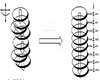
Dutch-sponsored researcher Ioan Paraschiv has stabilised new columnar discotic liquid crystals by making use of hydrogen bonds. This stabilisation approach yielded well-ordered, column-shaped aggregates that can transport charges. Liquid crystals are materials that combine the properties of a liquid with those of crystalline solids. |
|
|

| The content herein, unless otherwise known to be public domain, are Copyright 1995-2006 - SpaceDaily.AFP and UPI Wire Stories are copyright Agence France-Presse and United Press International. ESA PortalReports are copyright European Space Agency. All NASA sourced material is public domain. Additionalcopyrights may apply in whole or part to other bona fide parties. Advertising does not imply endorsement,agreement or approval of any opinions, statements or information provided by SpaceDaily on any Web page published or hosted by SpaceDaily. Privacy Statement |