|
 |
 |
 |
 |
 |
 |
 |
 |

 |
Liquid Crystals Stabilised
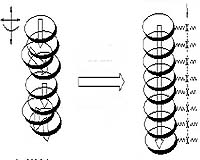
Amsterdam, Holland (SPX) Feb 01, 2007 Dutch-sponsored researcher Ioan Paraschiv has stabilised new columnar discotic liquid crystals by making use of hydrogen bonds. This stabilisation approach yielded well-ordered, column-shaped aggregates that can transport charges. Liquid crystals are materials that combine the properties of a liquid with those of crystalline solids. They show a middle phase, known as mesophase or liquid crystalline phase, in which the material has unique characteristics that can be used in liquid crystal display (LCD) screens and solar cells. One use of columnar discotic liquid crystals is charge transport in photovoltaic solar cells, where a high degree of order within the mesophase is required. Ioan Paraschiv investigated whether it is possible to stabilise columnar discotic liquid crystals using hydrogen bonds. For this, he prepared columnar discotic liquid crystals based on triphenylene core. He stabilised the ordering in the mesophase by realising a synergy between various bonding interactions. The mesophases of the newly-formed columnar discotic liquid crystals were found to be highly stable. Moreover, the material was still easy to process, due to its high solubility in organic solvents. This combination of stability and ease of processing is particularly important for the use of these materials in different applications. Community Email This Article Comment On This Article Related Links NWO All about the technology of space and more All about the technology of space and more Space Technology News - Applications and Research
 Novel Computer Imaging Technique Uses Blurry Images To Enhance View
 Champaign IL (SPX) Feb 07, 2007
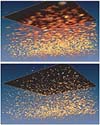
Researchers at the University of Illinois at Urbana-Champaign have developed a novel computational image-forming technique for optical microscopy that can produce crisp, three-dimensional images from blurry, out-of-focus data. Called Interferometric Synthetic Aperture Microscopy, ISAM can do for optical microscopy what magnetic resonance imaging did for nuclear magnetic resonance, and what computed tomography did for X-ray imaging, the scientists say. |
|
|

| The content herein, unless otherwise known to be public domain, are Copyright 1995-2006 - SpaceDaily.AFP and UPI Wire Stories are copyright Agence France-Presse and United Press International. ESA PortalReports are copyright European Space Agency. All NASA sourced material is public domain. Additionalcopyrights may apply in whole or part to other bona fide parties. Advertising does not imply endorsement,agreement or approval of any opinions, statements or information provided by SpaceDaily on any Web page published or hosted by SpaceDaily. Privacy Statement |