|
 |
 |
 |
 |
 |
 |
 |
 |

 |
Researchers Give Name To Ancient Mystery Creature
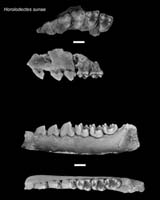
Edmonton, Canada (SPX) Oct 18, 2006 For the first time, researchers at the University of Alberta in Edmonton, Canada have been able to put a name and a description to an ancient mammal that still defies classification. The findings, published recently in the Journal of Paleontology provide the first and only comprehensive account of the creature, named Horolodectes sunae, for the unusual shape of the crowns of the teeth. Horolodectes lived about 60 million years ago, soon after the dinosaurs went extinct, in a period known for its rapid diversification of small mammals. Based on careful examination of tooth and jaw fragments that have been unearthed over the past 30 years, the University of Alberta researchers have now determined Horolodectes was a small fur-bearing animal that measured 10 centimetres in length and due to its powerful jaws, likely had a strong bite. Most confounding are the animal's teeth, which resemble in superficial ways, those of primitive relatives of ungulates, the group of mammals which includes horses and cows. But despite that link to ungulates, which are traditionally herbivores, Horolodectes was thought to have dined on small insects and grubs. "It had sharp crests on the teeth which formed blades, indicating it was likely carnivorous," said Craig Scott, a PhD candidate and lead author of the study. Horolodectes means 'hourglass biter', in reference to the creature's peculiar hourglass-shaped pre-molars, the teeth between the canine and the molars. The very tall, sharp pre-molars are unlike any others so far discovered in the mammal world. "There is nothing else with teeth quite like it," Craig said. "In an area of North America that's been fairly well studied, it's unusual to have a critter like this pop up. It's not known anywhere else, just in Alberta. And it's quite distinct. There's no mistaking it," Scott said. The first dental specimens of the creature were unearthed by University of Alberta paleontologists 30 years ago from the banks of the Blindman River in Alberta, Canada. About 10 years ago, more teeth were discovered at a dig site near Drayton Valley and on the banks of the Blindman. But the creature mystified the researchers, who could not positively identify it, and exactly where it fits into the evolutionary ladder is still unknown. Horolodectes remains an enigma to this day. "It's just too bizarre to place in any group that we've known about previously," said Scott. "It's an open question until we can find more of it. We have no information from a skull or other parts of the body." Community Email This Article Comment On This Article Related Links University of Alberta Darwin Today At TerraDaily.com Darwin Today At TerraDaily.com
 New Dwarf Buffalo Discovered By Chance In The Philippines
 Chicago IL (SPX) Oct 18, 2006
Almost 50 years ago, Michael Armas, a mining engineer from the central Philippines, discovered some fossils in a tunnel he was excavating while exploring for phosphate. Forty years later, Dr. Hamilcar Intengan, a friend of his who now lives in Chicago, recognized the importance of the bones and donated them to The Field Museum. |
|
|

| The content herein, unless otherwise known to be public domain, are Copyright 1995-2006 - SpaceDaily.AFP and UPI Wire Stories are copyright Agence France-Presse and United Press International. ESA PortalReports are copyright European Space Agency. All NASA sourced material is public domain. Additionalcopyrights may apply in whole or part to other bona fide parties. Advertising does not imply endorsement,agreement or approval of any opinions, statements or information provided by SpaceDaily on any Web page published or hosted by SpaceDaily. Privacy Statement |