|
 |
 |
 |
 |
 |
 |
 |
 |

 |
Researchers Discover Living Nanoscale 'Necklace'
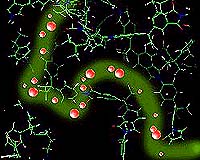
Santa Barbara CA (SPX) Nov 09, 2004 In an interdisciplinary endeavor at the University of California, Santa Barbara, a team of researchers in physics and biology have made a discovery at the nanoscale level that could be instrumental in the production of miniaturized materials with many applications. Dubbed a "living necklace," the finding was completely unexpected. This discovery could influence the development of vehicles for chemical, drug, and gene delivery, enzyme encapsulation systems and biosensors, circuitry components, as well as templates for nanosized wires and optical materials. The findings are reported in the November 16 issue of the Proceedings of the National Academy of Sciences and published online the week of November 8. The collaborating labs are those of Cyrus Safinya, professor of materials and physics and faculty member of the Biomolecular Science & Engineering Program, and Leslie Wilson, professor of biochemistry in the Department of Molecular, Cellular and Developmental Biology. The first author of the paper is Safinya's graduate student Daniel Needleman. Postdoctoral researchers Uri Raviv and Miguel Ojeda-Lopez from Safinya's group and Herbert Miller, a researcher in Wilson's group, completed the team. The scientists studied microtubules from the brain tissue of a cow to understand the mechanisms leading to their assembly and shape. Microtubules are nanometer-scale hollow cylinders derived from cell cytoskeleton. In an organism, microtubules and their assembled structures are critical components in a broad range of cell functions - from providing tracks for the transport of cargo to forming the spindle structure in cell division. Their functions include the transport of neurotransmitters in neurons. The mechanism of their assembly within an organism has been poorly understood. In the paper, the researchers report the discovery of a new type of higher order assembly of microtubules. Positively-charged large, linear molecules (tri-, tetra- and penta-valent cations) resulted in a tightly bundled hexagonal grouping of microtubules � a result that was predicted. But unexpectedly, the scientists found that small, spherical divalent cations caused the microtubules to assemble into a "necklace." They discovered distinct linear, branched and loop shaped necklaces. Safinya and Needleman commented that from a formal theoretical physics perspective, the living necklace phase is the first experimental realization of a new type of membrane where the long microtubule molecules are oriented in the same direction but can diffuse within the living membrane. They explained that the living necklace bundle is highly dynamic and that thermal fluctuations will cause it to change shape. The scientists envision applications based on both the tight bundle and living necklace phases. For example, metallization of necklace bundles with different sizes and shapes would yield nanomaterials with controlled optical properties. A more original application is in the area of using the assemblies � encased by a lipid bilayer � as drug or gene carriers where each nanotube may contain a distinct chemical, as noted by the team. In delivery applications the shape of the bundle determines its property. For example, the linear necklace phase with its higher surface to volume ratio would have a larger contact area and a faster delivery rate compared to the tight bundle phase. The work was performed using state-of-the-art synchrotron x-ray scattering techniques at the Stanford Synchrotron Radiation Laboratory combined with sophisticated electron and optical microscopy at UCSB. Community Email This Article Comment On This Article Related Links University of California, Santa Barbara SpaceDaily Search SpaceDaily Subscribe To SpaceDaily Express Nano Technology News From SpaceMart.com Computer Chip Architecture, Technology and Manufacture
 Prof Develops Cancer Nanobomb
 Newark DE (SPX) Oct 14, 2005
University of Delaware researchers are opening a new front in the war on cancer, bringing to bear new nanotechnologies for cancer detection and treatment and introducing a unique nanobomb that can literally blow up breast cancer tumors. |
|
|

| The content herein, unless otherwise known to be public domain, are Copyright 1995-2006 - SpaceDaily.AFP and UPI Wire Stories are copyright Agence France-Presse and United Press International. ESA PortalReports are copyright European Space Agency. All NASA sourced material is public domain. Additionalcopyrights may apply in whole or part to other bona fide parties. Advertising does not imply endorsement,agreement or approval of any opinions, statements or information provided by SpaceDaily on any Web page published or hosted by SpaceDaily. Privacy Statement |