
 |
 |
 |
 |
 |
 |
 |
 |
 |

 |

Washington DC (SPX) Jul 16, 2010 Physicists will soon have a better measure of the age of our galaxy, thanks to experiments described in a trio of papers appearing in the journal Physical Review C. The papers report on experiments at the CERN neutron time-of-flight (n_TOF) facility and the Karlsruhe Van de Graaff accelerator that clarify the processes that affect the abundance of the element osmium-187. The element is created when rhenium-187 decays. Because rhenium-187 was produced in the first stellar explosions after the birth of the galaxy, measuring the amounts of rhenium-187 and osmium-187 we observe today can provide an estimate of the galaxy's age. In effect, the elements act as a cosmic clock that started ticking when the galaxy was born. Unfortunately, there are various processes that can affect the amounts of osmium we measure. Uncertainties in our understanding of those processes have limited the accuracy of the cosmic clock to more than a billion years. The CERN and Karlsruhe experiments involve firing pulses of neutrons into an osmium target to determine how frequently the element is likely to capture neutrons and convert to another material. The data the researchers collected has reduced uncertainties in the rhenium-osmium cosmic clock to less than a billion years, allowing a better estimate of our roughly 14 billion year old galaxy.
Share This Article With Planet Earth
Related Links American Physical Society Understanding Time and Space

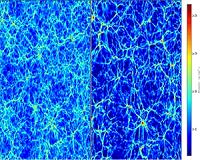 Extra Large Galactic Survey Puts Limits On Ultralight Particles
Washington DC (SPX) Jul 13, 2010 Physicists have long known that neutrinos are among the lightest and most evasive fundamental particles. Now a survey of the galaxies is helping to narrow down the neutrino mass even further. It seems that neutrinos are at best half as massive as previously estimated, according to an analysis appearing in the journal Physical Review Letters. The lower neutrino mass estimate is the re ... read more |
|
|
| The content herein, unless otherwise known to be public domain, are Copyright 1995-2010 - SpaceDaily. AFP and UPI Wire Stories are copyright Agence France-Presse and United Press International. ESA Portal Reports are copyright European Space Agency. All NASA sourced material is public domain. Additional copyrights may apply in whole or part to other bona fide parties. Advertising does not imply endorsement,agreement or approval of any opinions, statements or information provided by SpaceDaily on any Web page published or hosted by SpaceDaily. Privacy Statement |


 del.icio.us
 Digg
Digg Reddit
 YahooMyWeb
 Google
 Facebook


