|
 |
 |
 |
 |
 |
 |
 |
 |

 |
Ready, Set, Mutate...And May The Best Microbe Win
Houston TX (SPX) May 19, 2006 Even with modern genomic tools, it's a daunting task to find a smoking gun for Darwinian evolution. The problem lies in being able to say not just when and how a specific gene mutated but also how that one genetic change translated into real-world dominance of one population over another. Rice University biologists, using an ingenious experiment that forced bacteria to compete in a head-to-head contest for evolutionary dominance, today offer the first glimpse of how individual genetic-level adaptations play out as Darwinian natural selection in large populations. The results appear in the May 19 issue of Molecular Cell. "One of our most surprising findings is that an estimated 20 million point mutations gave rise to just six populations that were capable of vying for dominance," said lead researcher Yousif Shamoo, associate professor of biochemistry and cell biology. "This suggests that very few molecular pathways are available for a specific molecular response, and it points to the intriguing possibility of developing a system to predict the specific mutations that pathogens will use in order to become resistant to antibiotics." Rice's study involved the heat-loving bacteria G. stearothermophilus, which thrives at up to 73 degrees Celsius (163 F). Shamoo and graduate students Rafael Cou�ago and undergraduate Stephen Chen used a mutant strain of the microbe that was unable to make a key protein that the bacteria needed to regulate its metabolism at high temperatures. They grew the bacteria for one month in fermentor, raising the temperature a half degree Celsius each day. Over a span of 1,500 generations, the percentage of mutant strains inside the fermentor ebbed and flowed as the single-celled microbes competed for dominance. Eventually, one strain squeezed out almost all the competition by virtue of its ability to most efficiently metabolize food at high temperature. The metabolic protein required to thrive at high-temperature could only be made in one genetic region of the bacteria's DNA, meaning the researchers had only to characterize that small region of the genome for each new strain in order to measure evolutionary progress. The researchers sampled the fermentor for new strains every other day. Though millions of mutations in the target gene are believed to have occurred, only about 700 of those were capable of creating a new variant of the target gene. In all, the researchers identified 343 unique strains, each of which contained one of just six variants of the critical gene. The first of the six, dubbed Q199R, arose almost immediately, and was the dominant strain through the 500th generation. Around 62 degrees Celsius, the Q199R was unable to further cope with the rising temperature, and a new round of mutations occurred. Five new varieties � themselves mutant forms of Q199R � vied for final domination of the fermentor. Three of the five were driven to extinction within a couple of days, and the final two fought it out over the remaining three weeks of the test. The research included a raft of additional experiments as well. The team characterized each of the mutant proteins to document precisely how it aided in metabolic regulation. The fermentor experiment was repeated and the same mutations � and no others � were observed to develop again. Three of the six genes � the "winner," it's closest competitor and Q199R � were spliced back into the original form of the bacteria and studied, to rule out the possibility that mutations in other genes were responsible for the competitive advantage. Shamoo said it's significant that the mutations didn't arise where expected within the gene. Four of the six occurred in regions of the gene that are identical in both heat-resistant and non-heat-resistant forms of G. stearothermophilus. Shamoo said this strongly shows the dynamic nature of evolution at the molecular and atomic level. Shamoo said the most promising finding is the fact that the follow-up test produced precisely the same mutant genes. "The duplicate study suggests that the pathways of molecular adaptation are reproducible and not highly variable under identical conditions," Shamoo said. Community Email This Article Comment On This Article Related Links Rice University Darwin Today At TerraDaily.com
 Colombian Frog Believed Extinct Found Alive
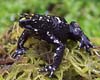 Washington DC (SPX) May 19, 2006
Researchers exploring a Colombian mountain range found surviving members of a species of Harlequin frog believed extinct due to a killer fungus wiping out amphibian populations in Central and South America. |
|
|

| The content herein, unless otherwise known to be public domain, are Copyright 1995-2006 - SpaceDaily.AFP and UPI Wire Stories are copyright Agence France-Presse and United Press International. ESA PortalReports are copyright European Space Agency. All NASA sourced material is public domain. Additionalcopyrights may apply in whole or part to other bona fide parties. Advertising does not imply endorsement,agreement or approval of any opinions, statements or information provided by SpaceDaily on any Web page published or hosted by SpaceDaily. Privacy Statement |