|
 |
 |
 |
 |
 |
 |
 |
 |

 |
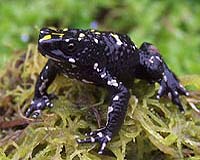
Colombian Frog Believed Extinct Found Alive
Washington DC (SPX) May 19, 2006 Researchers exploring a Colombian mountain range found surviving members of a species of Harlequin frog believed extinct due to a killer fungus wiping out amphibian populations in Central and South America. The discovery of what could be the last population of the painted frog (Atelopus ebenoides marinkellei) indicates the species has survived the fungus, providing hope that other species also might avoid elimination from the epidemic caused by a pathogenic fungus of unknown origin. Professor Carlos Rocha and a team of researchers from the Pedagogical and Technological University of Boyac� - UTPC supported by Conservation International, the Darwin Initiative and the Fund for Environmental Action and Childhood made the discovery in early May in the deserts of Sarna and Toquilla in Boyac� in eastern Colombia. The painted frog, which is found only in the deserts of Colombia's highlands, was last seen in 1995 in the area of Siscunsi, in the same region as Boyac�. After 11 years without a sighting, scientists considered the species extinct because of a lethal skin fungus, known as chytridiomycosis, and other hazards threatening the survival of a third of all amphibian species around the world. "The scientific importance of the finding must motivate us to adopt urgent measures toward saving the last of these amphibians, both in the wild and through captive breeding programs," said Fabio Arjona, executive director of Conservation International in Colombia. "That will require a lot of support from the local and international communities." The painted frog is one of 110 species of a diverse group of neo-tropical amphibians that live mostly in Colombia. The country's amphibian population is considered among the most diverse on Earth and key in the conservation efforts to protect amphibian species worldwide. So far, 42 of the 113 species of Atelopus found in the Tropical Andes Hotspot that includes parts of Colombia, Ecuador, Peru and Venezuela have experienced population declines of up to 50 percent. Frogs provide innumerable ecosystem services by consuming insects and serving as indicators of overall environmental health of an ecosystem. The disappearance of amphibians could cause numerous consequences, including an increase in illnesses such as malaria due to the disappearance of amphibians that feed on mosquitoes carrying the disease. An extinction crisis among amphibians indicates drastic environmental changes caused by human impact such as deforestation and global warming. The research was conducted as part of the Atelopus Initiative, a regional program that monitors the state of amphibian populations in the Tropical Andes Hotspot. CI will work with partners on extending Atelopus conservation initiatives into Peru and Bolivia under the Amphibian Conservation Action Plan created in 2005 as result of the 2004 Global Amphibian Assessment. Community Email This Article Comment On This Article Related Links Conservation International The Darwin Initiative Darwin Today At TerraDaily.com
 Small Molecule Interactions Were Central To The Origin Of Life
 New York NY (SPX) May 17, 2006
In an important new paper forthcoming in the June issue of The Quarterly Review of Biology, Robert Shapiro (New York University) argues against the widely held theory that the origin of life began with the spontaneous appearance of a large, replicating molecule such as RNA. |
|
|

| The content herein, unless otherwise known to be public domain, are Copyright 1995-2006 - SpaceDaily.AFP and UPI Wire Stories are copyright Agence France-Presse and United Press International. ESA PortalReports are copyright European Space Agency. All NASA sourced material is public domain. Additionalcopyrights may apply in whole or part to other bona fide parties. Advertising does not imply endorsement,agreement or approval of any opinions, statements or information provided by SpaceDaily on any Web page published or hosted by SpaceDaily. Privacy Statement |