|
 |
 |
 |
 |
 |
 |
 |
 |

 |
Pure Carbon Nanotubes Pass First In Vivo Test
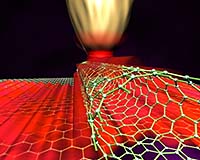
Houston TX (SPX) Nov 29, 2006 In the first experiments of their kind, researchers at Rice University and The University of Texas M. D. Anderson Cancer Center have determined that carbon nanotubes injected directly into the bloodstream of research lab animals cause no immediate adverse health effects and circulate for more than one hour before they are removed by the liver. The findings are from the first in vivo animal study of chemically unmodified carbon nanotubes, a revolutionary nanomaterial that many researchers hope will prove useful in diagnosing and treating disease. The research will appear in this week's online edition of the Proceedings of the National Academy of Sciences. "We sampled tissues from a dozen organs, and found significant amounts of nanotubes only in the liver," said lead author Bruce Weisman, professor of chemistry. "The liver naturally removes drugs or compounds from the blood, so this is what we expected to find." The study, which tracked where the nanotubes went within 24 hours of being injected, also revealed trace amounts of nanotubes in the kidneys - another common expulsion route for drugs. There was no evidence that nanotubes remained in other tissues in the body. Nanotubes are hollow cylinders of pure carbon that measure just one nanometer in diameter - about the same width as a strand of DNA. Nanotubes have unique chemical and optical properties, and they have attracted intense interest from biomedical researchers. "The early results are promising for anyone interested in using carbon nanotubes in biomedical applications," said co-author Dr. Steven Curley, professor of surgical oncology and chief of gastrointestinal tumor surgery at M. D. Anderson. "We are particularly pleased that the fluorescent effect remains intact in our application, because this makes it easier to see where the nanotubes end up, and it opens the door to some exciting diagnostic and therapeutic applications." In a ground-breaking 2002 study, Weisman and colleagues at Rice, including the late Professor Richard Smalley, discovered that nanotubes fluoresce, or emit near infrared light. Because near-infrared light passes harmlessly into the body, biomedical researchers are keen to use carbon nanotubes for the noninvasive diagnosis and treatment of diseases such as cancer and atherosclerosis. In the current study, Weisman, Curley and colleagues injected lab animals with water soluble single-walled carbon nanotubes. The nanotubes, whose biocompatible coating was displaced by proteins in the blood, continued to fluoresce in the animals. "I still remember how excited we were when we confirmed that the tubes were fluorescing," said Paul Cherukuri, a doctoral degree candidate in Chemistry. The researchers used this fluorescence to track the nanotubes in the blood and image them in tissues under the microscope. Cherukuri said Smalley initiated several follow-up projects shortly before his passing in 2005 from lymphoma. In one, researchers are working on methods that will allow nanotubes to circulate longer following injection, so that they can be more easily targeted to specific organs. In another, they are tracking the longer-term behavior and effects of nanotubes in research lab animals. "This research grew out of Smalley's vision, and he followed our progress and offered daily guidance, even from his hospital bed at M.D. Anderson," Cherukuri said. "Up to his very last day, he was simultaneously fighting his own battle with cancer and developing new ways to treat the disease that ultimately took his life. These new results are simply the first fruits of his final contributions in nanohealth research, and there are still more to come." Community Email This Article Comment On This Article Related Links Rice University Nano Technology News From SpaceMart.com Computer Chip Architecture, Technology and Manufacture
 NASA Works With ISM To Commercialise Nanotube Technology
 Boston MA (SPX) Nov 10, 2006
As researchers gather for the National Nano Engineering Conference in Boston November 9-10, they will have the opportunity to learn about how a NASA-developed innovative process is making a big impact in nanotechnology. |
|
|

| The content herein, unless otherwise known to be public domain, are Copyright 1995-2006 - SpaceDaily.AFP and UPI Wire Stories are copyright Agence France-Presse and United Press International. ESA PortalReports are copyright European Space Agency. All NASA sourced material is public domain. Additionalcopyrights may apply in whole or part to other bona fide parties. Advertising does not imply endorsement,agreement or approval of any opinions, statements or information provided by SpaceDaily on any Web page published or hosted by SpaceDaily. Privacy Statement |