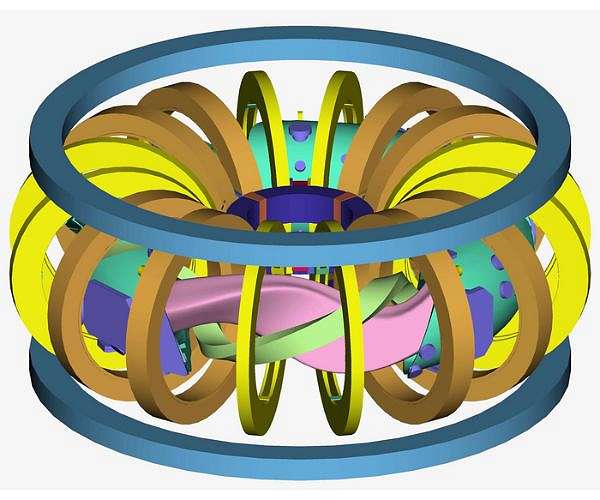
Researchers in Japan have directly observed that turbulence in magnetically confined fusion plasmas serves two distinct functions, both transporting heat and linking distant regions so that temperature changes can spread almost instantly across the plasma volume.
The team at the National Institute for Fusion Science used the Large Helical Device (LHD), a large superconducting helical confinement experiment in Toki, Gifu, to study how heat and turbulence propagate when the plasma core is briefly heated. They applied short heat pulses and monitored the response with high precision diagnostic systems that use electromagnetic waves at multiple wavelengths to track electron temperature, turbulence, and heat flow with microsecond time resolution and millimeter spatial resolution.
Measurements showed that soon after the core heating, a form of mediator turbulence appeared that coupled separated regions of the plasma in less than one ten thousandth of a second, so that remote locations responded almost simultaneously. This mediator turbulence acts as a relay that rapidly passes heat and energy between distant zones, similar to players quickly passing a ball across a field. Following this initial phase, a second class of turbulence transported heat more gradually outward, shaping the steady temperature profile like a player advancing while holding the ball.
The experiments further indicated that shortening the duration of the heat pulse strengthened the mediator turbulence and led to faster heat spreading across the plasma. Taken together, the observations demonstrate that turbulence in magnetically confined plasmas performs a two-in-one role: it directly carries heat outward and simultaneously connects far-apart regions so that heat can redistribute suddenly across the entire device.
This work represents the first high resolution experimental identification of mediator-type turbulence that links distant parts of a confined plasma, along with the first direct demonstration that such turbulence simultaneously drives local and nonlocal heat transport. The results help explain how heat injected at the core can reach the edge rapidly and provide a basis for predictive models and control strategies for heat transport in future fusion reactors, including approaches that suppress or modify mediator turbulence to improve energy confinement. Because similar long-range coupling appears in systems such as ocean and atmospheric circulation and energy transfer in materials, the findings may also inform research in other areas of physics and geoscience.