
 |
 |
 |
 |
 |
 |
 |
 |
 |

 |
Physicists closer to quantum computing
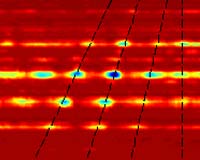
Berkeley, Calif. (UPI) Oct 28, 2008 A team of U.S. and British physicists reports taking a step toward quantum computing by successfully using a single atomic nucleus as solid-state memory. Researchers from the U.S. Department of Energy's Lawrence Berkeley National Laboratory, Oxford University and Princeton University said they precisely doped exceptionally pure and isotopically controlled crystals of silicon with phosphorus atoms. Quantum information was processed in the phosphorus electrons, transferred to the phosphorus nuclei and then subsequently transferred back to the electrons. The scientists said that was the first demonstration that a single atomic nucleus can serve as quantum computational memory. "In this exciting collaboration �� we have reported on a very important demonstration of coherent information transfer between the electron spin (processing qubit) and the nuclear spin (memory qubit) of phosphorus atoms in isotopically enriched silicon crystals," said study co-author Thomas Schenkel, a physicist in Berkeley Lab's Accelerator and Fusion Research Division. "The electron spin information was faithfully stored in the nuclear spin for nearly two seconds (thousands of times longer than ever reported previously) and then transferred back to the electron spin with about 90-percent fidelity," Schenkel said. The experiment is reported in the Oct. 23 issue of the journal Nature. Community Email This Article Comment On This Article Share This Article With Planet Earth
Related Links Super Computer News and HPC Technology
 Voltaire Powers World's Most Powerful Supercomputer For NNSA's Los Alamos
 Dresden, Germany (SPX) Jul 02, 2008
Voltaire has announced that the company's InfiniBand-based switches are powering the world's largest supercomputer for the National Nuclear Security Administration's (NNSA) Los Alamos National Laboratory. |
|
|

| The content herein, unless otherwise known to be public domain, are Copyright 1995-2007 - SpaceDaily.AFP and UPI Wire Stories are copyright Agence France-Presse and United Press International. ESA Portal Reports are copyright European Space Agency. All NASA sourced material is public domain. Additional copyrights may apply in whole or part to other bona fide parties. Advertising does not imply endorsement,agreement or approval of any opinions, statements or information provided by SpaceDaily on any Web page published or hosted by SpaceDaily. Privacy Statement |
 del.icio.us
 Digg
Digg Reddit
 YahooMyWeb
 Google
 Facebook