|
 |
 |
 |
 |
 |
 |
 |
 |

 |
Orbital Minotaur launches XSS-11 Research Satellite
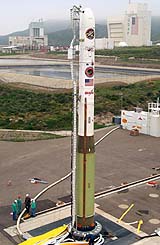
Dulles VA (SPX) Apr 13, 2005 Orbital Sciences has successfully launched the XSS-11 satellite aboard a Minotaur I rocket. The XSS-11 is an experimental small satellite for the US Air Force designed to test technologies that could allow quick visual examinations or maintenance of spacecraft in orbit. The mission originated on Monday, April 11, 2005, at 9:35 a.m. (EDT) from Vandenberg Air Force Base, CA (VAFB) when the Minotaur rocket ignited its first stage motor and lifted-off from its West Coast launch site. Approximately 12 minutes after launch, the XSS-11 satellite was inserted into its targeted orbit of approximately 850 kilometers above the Earth. Yesterday's mission was the third flight the Minotaur I space launch vehicle, all of which have been successful. Since the program's first flight in 2000, the Minotaur family of space and suborbital launch vehicles has carried out eight launches with 100% success. Over the next three years, Minotaur rockets are scheduled to conduct another nine launches, including the first flights of the larger Peacekeeper-based vehicles. The Minotaur I space launch vehicle used in yesterday's successful launch of the XSS-11 satellite is the first in Orbital's Minotaur product line, which includes both space launch vehicles as well as long-range missile defense targets and other suborbital vehicles. The rockets are derived from U.S. Government-supplied Minuteman and Peacekeeper rocket motors. The space launch configurations combine commercial rocket motors, avionics and other elements with the government-supplied stages to create responsive, reliable and low-cost launch systems for U.S. government payloads. The Minotaur I configuration includes Minuteman rocket motors that serve as the vehicle's first and second stages, efficiently reusing motors that have been previously decommissioned. Its third and fourth stages, structures and payload fairing are common with Orbital's highly reliable Pegasus XL rocket. The Minotaur I space launch vehicle made its inaugural flight in January 2000, successfully delivering a number of small military and university satellites into orbit and marking the first-ever use of residual U.S. Government Minuteman boosters in a space launch vehicle. Its second mission was carried out less than six months later, in July 2000, with the launch of a technology demonstration satellite for the U.S. Air Force Research Laboratory. Community Email This Article Comment On This Article Related Links Orbital SpaceDaily Search SpaceDaily Subscribe To SpaceDaily Express Launch Pad at Space-Travel.com
 Soyuz To Launch Radarsat-2
 Evry, France (SPX) Jan 11, 2006
Starsem announced Monday the signing of a contract with MacDonald, Dettwiler and Associates (MDA) for the launch of MDA's RADARSAT-2 Earth observation satellite by a Soyuz launch vehicle. |
|
|

| The content herein, unless otherwise known to be public domain, are Copyright 1995-2006 - SpaceDaily.AFP and UPI Wire Stories are copyright Agence France-Presse and United Press International. ESA PortalReports are copyright European Space Agency. All NASA sourced material is public domain. Additionalcopyrights may apply in whole or part to other bona fide parties. Advertising does not imply endorsement,agreement or approval of any opinions, statements or information provided by SpaceDaily on any Web page published or hosted by SpaceDaily. Privacy Statement |