|
 |
 |
 |
 |
 |
 |
 |
 |

 |
Orbital Awarded Contract For System F6 Satellite Program By DARPA
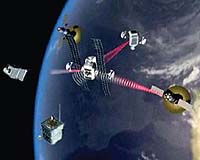
Dulles VA (SPX) Feb 29, 2008 Orbital Sciences has announced that it has been selected by the Defense Advanced Research Projects Agency (DARPA) to develop a Phase 1 concept for System F6 (Future Fast, Flexible, Fractionated, Free-Flying Spacecraft united by Information eXchange). DARPA is the central research and development organization for the Department of Defense (DoD). It manages and directs selected basic and applied research and development projects for DoD, and pursues research and technology where risk and payoff are both very high and where success may provide dramatic advances for traditional military roles and missions. The objective of the F6 program is to demonstrate the feasibility and benefits of a satellite architecture in which traditional "monolithic" spacecraft are replaced by clusters of wirelessly-interconnected spacecraft modules. "F6 has the potential to be a game-changing event in the history of military space systems in the same way that the internet revolutionized data communications," stated Mr. Gregg Burgess, Orbital's Vice President for National Security Systems in the Advanced Programs Group. "DARPA and Orbital have had a long and productive partnership leading to major innovations such as the Pegasus launch vehicle and numerous advanced small satellites. System F6 could transform today's military space architecture to create a truly networked system of systems in space." Community Email This Article Comment On This Article Related Links Orbital Read the latest in Military Space Communications Technology at SpaceWar.com
 Lockheed Martin Completes Rigorous Test Of First Advanced Military Communications Satellite
 Sunnyvale CA (SPX) Feb 29, 2008
Lockheed Martin has successfully completed acoustic testing of the first Advanced Extremely High Frequency (AEHF) military communications satellite. The Advanced EHF system will provide survivable, highly secure, protected, global communications for all warfighters serving under the U.S. Department of Defense. |
|
|

| The content herein, unless otherwise known to be public domain, are Copyright 1995-2007 - SpaceDaily.AFP and UPI Wire Stories are copyright Agence France-Presse and United Press International. ESA Portal Reports are copyright European Space Agency. All NASA sourced material is public domain. Additional copyrights may apply in whole or part to other bona fide parties. Advertising does not imply endorsement,agreement or approval of any opinions, statements or information provided by SpaceDaily on any Web page published or hosted by SpaceDaily. Privacy Statement |