|
 |
 |
 |
 |
 |
 |
 |
 |

 |
Opportunity Examines Crater Ejecta And Grinds into Rock
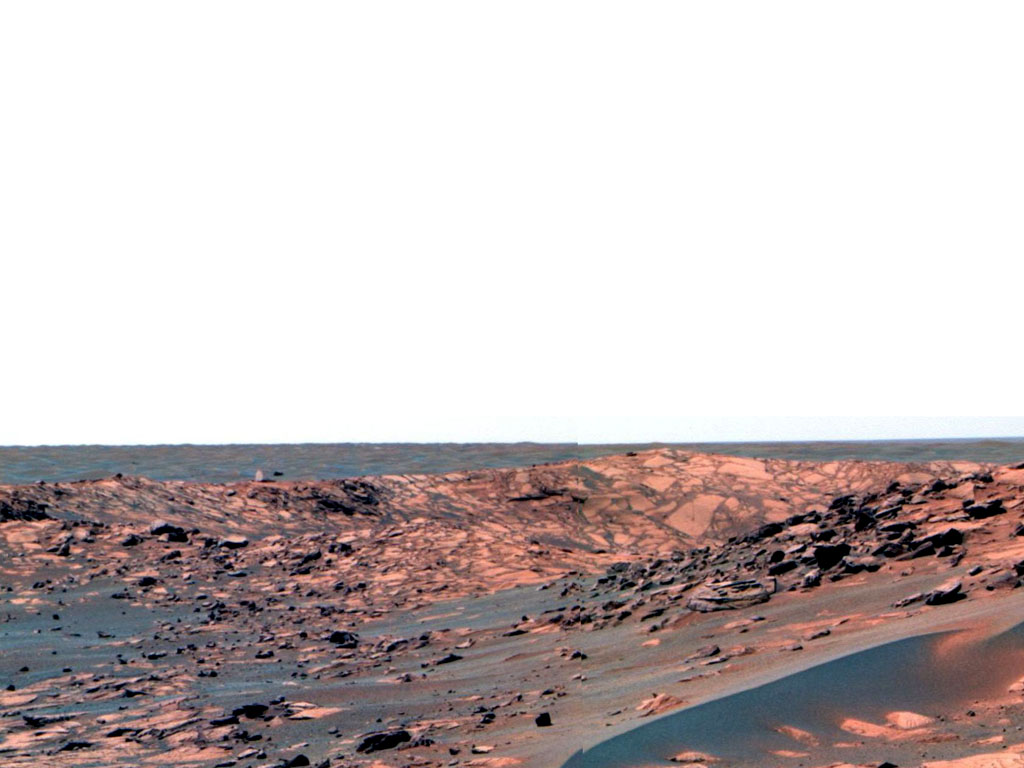
Pasadena CA (JPL) Aug 07, 2006 After traversing the sandy plains of Meridiani to "Beagle Crater," Opportunity investigated a patch of outcrop pavement thought to be representative of the Martian surface beyond the reach of materials excavated by the impacts that dug Beagle and the nearby, much larger Victoria Crater. Opportunity used its rock abrasion tool to grind away the surface of rock for the first time since the rover's 691st sol, or Martian day (Jan. 3, 2006). Both before and after grinding beneath the surface of the rock target known as "Baltra," Opportunity took microscopic images and collected data with the alpha particle X-ray spectrometer and the Moessbauer spectrometer. The rover remains healthy. This weekend, the science team plans to launch a three-day imaging campaign of Beagle Crater and the surrounding area. Sol-by-sol summaries Sol 893 (July 29, 2006): Opportunity took microscopic images of Baltra and the grinding bit on the rock abrasion tool, ground 3 millimeters (0.12 inch) beneath the surface of Baltra, and took images of the magnets on the rock abrasion tool both before and after the grind. After communicating with NASA's Mars Odyssey orbiter, the rover began a study of Baltra with the alpha particle X-ray spectrometer and surveyed the sky and ground with the miniature thermal emission spectrometer. The rover turned off the alpha particle X-ray spectrometer at 11:13 p.m., local Mars time, before going into a mini-deep sleep. Sol 894: Opportunity took stereo microscopic images of Baltra following the grind. The rover spent 12 hours collecting data from the freshly ground surface with the Moessbauer spectrometer. Opportunity acquired panoramic camera images of the rim of Beagle Crater and a transitional area around Beagle Crater known as "Espa�ola." Sol 895: Opportunity acquired panoramic camera images of a flat rock target known as "Bartolom�" and conducted Moessbauer analysis of Baltra. Opportunity completed a very long survey of atmospheric dust, known as a tau measurement, with the panoramic camera and surveyed the sky and ground with the miniature thermal emission spectrometer. The rover went into deep sleep to recharge the batteries. Sol 896: Opportunity rolled back 1 meter (3.3 feet) and acquired color images of Baltra using all 13 filters of the panoramic camera, then drove 21 meters (69 feet) toward the edge of Beagle Crater. At the end of the drive, the rover acquired images of the terrain using the navigation and panoramic cameras. Sol 897: Opportunity recharged the batteries and conducted untargeted remote sensing of infrared energy and dust using the miniature thermal emission spectrometer (beginning with looking at the calibration target) and the panoramic camera. The rover surveyed the ground and sky with the miniature thermal emission spectrometer while communicating with the Odyssey orbiter. Sol 898: Opportunity acquired panoramic camera images before driving 5 meters (16 feet) toward the rim of Beagle Crater. After the drive, Opportunity acquired images with the navigation camera and data with the miniature thermal emission spectrometer. Sol 899 (Aug. 4, 2006): Plans called for a deep sleep followed by turning on the miniature thermal emission spectrometer heaters at 7 a.m., surveying the sky with the panoramic camera, and collecting data from the sky and ground using the miniature thermal emission spectrometer. Odometry As of sol 897 (Aug. 2, 2006), Opportunity's total odometry was 8,681.96 meters (5.39 miles). Community Email This Article Comment On This Article Related Links Mars Rovers at JPL Mars Rovers at Cornell Mars News and Information at MarsDaily.com Lunar Dreams and more
 Scientists Suggest Solution To 30-Year-Old Martian Mystery
 Greenbelt, MD (SPX) Aug 04, 2006
Electricity generated in dust storms on Mars may produce reactive chemicals that build up in the Martian soil, according to NASA-funded research. The chemicals, like hydrogen peroxide (H2O2), may have caused the contradictory results when NASA's Viking landers tested the Martian soil for signs of life, according to the researchers. |
|
|

| The content herein, unless otherwise known to be public domain, are Copyright 1995-2006 - SpaceDaily.AFP and UPI Wire Stories are copyright Agence France-Presse and United Press International. ESA PortalReports are copyright European Space Agency. All NASA sourced material is public domain. Additionalcopyrights may apply in whole or part to other bona fide parties. Advertising does not imply endorsement,agreement or approval of any opinions, statements or information provided by SpaceDaily on any Web page published or hosted by SpaceDaily. Privacy Statement |