|
 |
 |
 |
 |
 |
 |
 |
 |

 |
Oozing Across Titan
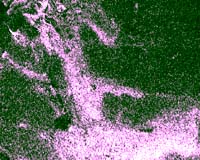
Pasadena CA (JPL) Nov 09, 2004 This synthetic aperture radar image of the surface of Saturn's moon Titan was acquired on Oct. 26, 2004, when the Cassini spacecraft flew approximately 2,500 kilometers (1,553 miles) above the surface and acquired radar data for the first time. The radar illumination was from the south: dark regions may represent areas that are smooth, made of radar-absorbing materials, or are sloped away from the direction of illumination. A striking bright feature stretches from upper left to lower right across this image, with connected 'arms' to the East. The fact that the lower (southern) edges of the features are brighter is consistent with the structure being raised above the relatively featureless darker background. Comparisons with other features and data from other instruments will help to determine whether this is a cryovolcanic flow, where water-rich liquid has welled up from Titan's warm interior. The image covers an area about 150 kilometers (90 miles) square, and is centered at about 45 degrees north, 30 degrees west in the northern hemisphere of Titan, over a region that has not yet been imaged optically. The smallest details seen on the image are around 1 kilometer (.62 mile) across. Features are less clear at the bottom of the image where the viewing was less favorable. A faint horizontal seam between the radar beams can be seen half way up in this image. Community Email This Article Comment On This Article Related Links Cassini-Huygens mission at JPL SpaceDaily Search SpaceDaily Subscribe To SpaceDaily Express Explore The Ring World of Saturn and her moons Jupiter and its Moons The million outer planets of a star called Sol News Flash at Mercury
 Cassini Images Halo Around Titanic Moon Off Saturn
 Pasadena CA (SPX) Dec 27, 2005
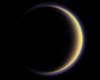
With its thick, distended atmosphere, Titan's orange globe shines softly, encircled by a thin halo of purple light-scattering haze. |
|
|

| The content herein, unless otherwise known to be public domain, are Copyright 1995-2006 - SpaceDaily.AFP and UPI Wire Stories are copyright Agence France-Presse and United Press International. ESA PortalReports are copyright European Space Agency. All NASA sourced material is public domain. Additionalcopyrights may apply in whole or part to other bona fide parties. Advertising does not imply endorsement,agreement or approval of any opinions, statements or information provided by SpaceDaily on any Web page published or hosted by SpaceDaily. Privacy Statement |