|
 |
 |
 |
 |
 |
 |
 |
 |

 |
Of Craters and Erosion: Opportunity Examines "Beagle"
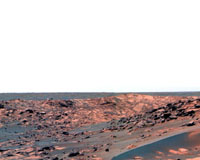
Pasadena CA (SPX) Sep 18, 2006 This 360-degree view shows Opportunity's last stop on the now-familiar surface of Meridiani Planum before reaching different terrains associated with the very large "Victoria Crater." In the center of the mosaic is "Beagle Crater," an impact crater about 35 meters (115 feet) wide. On the far left and wrapping around to the far right, Opportunity's tracks are visible approaching the crater. Though it looks relatively fresh in orbital images, from a closer vantage point Beagle Crater appears moderately eroded. The crater walls are slumped and the middle of the crater bowl is filled with rippled sand. However, a slightly raised crater rim remains, and in a few places (for instance, on the inside left wall), cliffs of outcrop appear to be preserved in the crater. Ejected rocks from Beagle Crater surround the rover, many with the distinctive, fine-grained layering commonly seen in the rocks of Meridiani Planum. Many of these rocks have surfaces smoothed by wind erosion. Wind erosion also formed the sand drifts nestled among the rocks. Because impact craters have well-understood shapes when they form, the altered appearance of eroded craters gives scientists clues to the processes that modified them. By observing how filled an impact crater has become and how worn its edges are, scientists can estimate how long its surface has been exposed to erosion. The many-sided outline of a crater such as Beagle and the blocky appearance of its ejecta may also tell scientists about the strength of the underlying bedrock. Based on observations such as these, scientists know that Beagle Crater is fresher than "Eagle" and "Fram" craters near Opportunity's landing site and more similar in form to "Viking" and "Voyager" craters in the plains to the north of Beagle. Opportunity made other observations at Beagle Crater, such as spectroscopic measurements taken with the panoramic camera and the miniature thermal emission spectrometer, to help scientists assess the composition of the rocks and determine whether Beagle Crater was excavated into the surface rocks of Meridiani Planum or into the ejecta blanket of Victoria Crater. Beagle Crater takes its unofficial name from a great ship of exploration, the HMS Beagle, whose most famous passenger was British naturalist Charles Darwin. During the Beagle expedition around the world, Darwin conducted many of the observations that led to his theory of natural selection. Scientists have unofficially named many rocks and features in the area of Beagle Crater after the Galapagos Islands and the varieties of finches Darwin observed there. The name Beagle Crater also commemorates the European Space Agency's ill-fated Beagle 2 lander, the loss if which is a reminder of how difficult space exploration can be. Opportunity took the mosaic of images that make up this 360-degree view of the rover's surroundings with the panoramic camera on the rover's 901st through 904th sols, or Martian days (Aug. 6 through Aug. 9, 2006), of exploration. This is an approximate true-color image combining exposures taken through the panoramic camera's 753-nanometer, 535-namometer, and 432-nanometer filters. Community Email This Article Comment On This Article Related Links Mars Rovers at JPL Mars Rovers at Cornell Mars News and Information at MarsDaily.com Mars News and Information at MarsDaily.com Lunar Dreams and more
 Peroxide Snow Hampers Search For Martians
 Berkeley CA (SPX) Sep 13, 2006
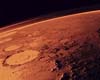
The planet-wide dust storms that periodically cloak Mars in a mantle of red may be generating a snow of corrosive chemicals - including hydrogen peroxide - that would be toxic to life, U.S. researchers say. |
|
|

| The content herein, unless otherwise known to be public domain, are Copyright 1995-2006 - SpaceDaily.AFP and UPI Wire Stories are copyright Agence France-Presse and United Press International. ESA PortalReports are copyright European Space Agency. All NASA sourced material is public domain. Additionalcopyrights may apply in whole or part to other bona fide parties. Advertising does not imply endorsement,agreement or approval of any opinions, statements or information provided by SpaceDaily on any Web page published or hosted by SpaceDaily. Privacy Statement |