|
 |
 |
 |
 |
 |
 |
 |
 |

 |
Peroxide Snow Hampers Search For Martians
Berkeley CA (SPX) Sep 13, 2006 The planet-wide dust storms that periodically cloak Mars in a mantle of red may be generating a snow of corrosive chemicals - including hydrogen peroxide - that would be toxic to life, U.S. researchers say. Based on field studies on Earth, laboratory experiments and theoretical modeling, the researchers argue that oxidizing chemicals could be produced by the static electricity generated in the swirling dust clouds that often obscure the surface for months. If these chemicals have been produced regularly over the last 3 billion years, when Mars has presumably been dry and dusty, the accumulated peroxide in the surface soil could have built to levels that would kill "life as we know it," said Gregory T. Delory of the University of California, Berkeley, lead author of one of the papers, published in the U.S. journal Astrobiology. "If true, this very much affects the interpretation of soil measurements made by the Viking landers in the 1970s," said Delory. A major goal of the Viking mission, comprised of two spacecraft launched by NASA in 1975, was testing Mars' red soil for signs of life. In 1976, the two landers aboard the spacecraft settled on the Martian surface and conducted four separate tests, including some that involved adding nutrients and water to the dirt and sniffing for gas production, which could be a telltale sign of living microorganisms. The tests were inconclusive because gases were produced only briefly, and other instruments found no traces of organic materials that would be expected if life were present. These results are more indicative of a chemical reaction than the presence of life, Delory said. "The jury is still out on whether there is life on Mars, but it's clear that Mars has very chemically reactive conditions in the soil," he said. "It is possible there could be long-term corrosive effects that would impact crews and equipment due to oxidants in the Martian soil and dust." All in all, he said, "the intense ultraviolet exposure, the low temperatures, the lack of water and the oxidants in the soil would make it difficult for any microbe to survive on Mars." In one of their papers, Delory and his colleagues demonstrate that the electrical fields generated in storms and smaller tornadoes - called dust devils - could split carbon dioxide and water molecules apart, allowing them to recombine as hydrogen peroxide or more complicated superoxides. All of these oxidants react readily with and destroy other molecules, including organic molecules that are associated with life. A second paper, co-authored by Delory, demonstrates that these oxidants could form and reach such concentrations near the ground during a storm that they would condense into falling snow, contaminating the top layers of soil. If this scenario has played out on Mars for much of its history, the accumulated peroxide in the soil could have fooled the Viking experiments looking for life. While the landers detected gas when water and nutrients were added to Martian soil, the landers' Mass Spectrometer experiment found no organic matter. At the time, researchers suggested that very reactive compounds in the soil, perhaps hydrogen peroxide or ozone, could have produced the measurements, imitating the response of living organisms. Others suggested a possible source for these oxidants: chemical reactions in the atmosphere catalyzed by ultraviolet light from the sun, which is more intense because of Mars' thin atmosphere. The predicted levels were far lower than needed to produce the Viking results, however. Production of oxidants by dust storms and dust devils, which seem to be common on Mars, would be sufficient to cause the Viking observations, Delory said. Thirty years ago, some researchers considered the possibility that dust storms might be electrically active, like Earth's thunderstorms, and that these storms might be a source of the new reactive chemistry. But this had been untestable until now. "The presence of peroxide may explain the quandary we have had with Mars," said Delory. "But there is still a lot we don't understand about the chemistry of the atmosphere and soils of the planet." Community Email This Article Comment On This Article Related Links Mars News and Information at MarsDaily.com Mars News and Information at MarsDaily.com Lunar Dreams and more
 NASA Mars Reconnaissance Orbiter Reaches Planned Flight Path
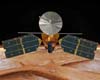 Pasadena CA (SPX) Sep 13, 2006
NASA's newest spacecraft at Mars has completed the challenging half-year task of shaping its orbit to the nearly circular, low-altitude pattern from which it will scrutinize the planet. The Mars Reconnaissance Orbiter fired its six intermediate-size thrusters for 12.5 minutes Monday afternoon, Sept. 11, shifting the low point of its orbit to stay near the Martian south pole and the high point to stay near the north pole. |
|
|

| The content herein, unless otherwise known to be public domain, are Copyright 1995-2006 - SpaceDaily.AFP and UPI Wire Stories are copyright Agence France-Presse and United Press International. ESA PortalReports are copyright European Space Agency. All NASA sourced material is public domain. Additionalcopyrights may apply in whole or part to other bona fide parties. Advertising does not imply endorsement,agreement or approval of any opinions, statements or information provided by SpaceDaily on any Web page published or hosted by SpaceDaily. Privacy Statement |