|
 |
 |
 |
 |
 |
 |
 |
 |

 |
Novel Salamander Robot Crawls Its Way Up The Evolutionary Ladder
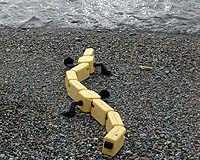
Lausanne, France (SPX) Mar 09, 2007 A group of European researchers has developed a spinal cord model of the salamander and implemented it in a novel amphibious salamander-like robot. The robot changes its speed and gait in response to simple electrical signals, suggesting that the distributed neural system in the spinal cord holds the key to vertebrates' complex locomotor capabilities. In a paper appearing in the March 9, 2007 issue of the journal Science, scientists from the EPFL in Switzerland and the INSERM research center/University of Bordeaux in France introduce their robot, Salamandra Robotica. This four-legged yellow creature reveals a great deal about the evolution of vertebrate locomotion. It's also a vivid demonstration that robots can be used to test and verify biological concepts, and that very often nature herself offers ideal solutions for robotics design. The researchers used a numerical model of the salamander's spinal cord to explore three fundamental issues related to this vertebrate's movement: what were the changes in the spinal cord that made it possible to evolve from aquatic to terrestrial locomotion? How are the limb and axial movements coordinated? And how is a simple electrical signal from the brain stem translated by the spinal cord into a change in gait? Once they thought they had answers to these questions, the team implemented the model - a system of coupled oscillators representing the neural networks in the spinal cord - on a primitive salamander-like robot. Simple electrical signals, like the signals sent from the upper brain to the spinal cord, were sent wirelessly from a laptop to the robot. These signals were enough to cause the robot to change its speed and direction and change from walking to swimming. The model therefore provides a potential explanation - relevant for all four-legged organisms - of how agile locomotion is controlled by distributed neural mechanisms located in the spinal cord. The robot serves here as a useful tool for neurobiology, explains EPFL professor Auke Ijspeert. "We used the robot to show that our model actually reflects reality. The robot was very useful to validate that our model could effectively modulate speed, direction and gait - aspects that need a mechanical "body" to be properly evaluated - and also to verify that the generated movements are close to those of a real salamander." This research may ultimately point to a way to gain better understanding of the more sophisticated circuits in the human spinal cord. If the control signals received by the spinal cord could be identified, perhaps it would be possible to re-initiate these by electrical stimulations in patients with spinal cord injuries. And it's a vivid demonstration that biology offers unique ideas for robotics design. "Nature found a nice way of making a sophisticated circuit in the spinal cord and then controlling the muscles from there," notes Ijspeert. "It's a fantastic solution for coordinating multiple degrees of freedom in a simple distributed way." Robots that could change their speed, direction, and gait based on simple remote signals, like living organisms, would be extremely useful in search and rescue operations, for example. Community Email This Article Comment On This Article Related Links Ecole Polytechnique Federale de Lausanne All about the robots on Earth and beyond! All about the robots on Earth and beyond!
 Look Ma, No Hands, No Humans
 Huntsville AL (SPX) Mar 06, 2007
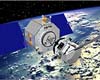
It's the year 2020, and space has never been so busy. Picture this: In Earth orbit, a robotic maintenance ship skitters from one weather satellite to another, upgrading powerful optics that help meteorologists track dangerous storms. Four hundred thousand kilometers away, a cargo ferry arrives at the Moon. It spots an orbiting depot, makes its approach and mates flawlessly, offloading drill heads, solar panels and other supplies for a frontier outpost at the Moon's south pole. |
|
|

| The content herein, unless otherwise known to be public domain, are Copyright 1995-2006 - SpaceDaily.AFP and UPI Wire Stories are copyright Agence France-Presse and United Press International. ESA PortalReports are copyright European Space Agency. All NASA sourced material is public domain. Additionalcopyrights may apply in whole or part to other bona fide parties. Advertising does not imply endorsement,agreement or approval of any opinions, statements or information provided by SpaceDaily on any Web page published or hosted by SpaceDaily. Privacy Statement |