|
 |
 |
 |
 |
 |
 |
 |
 |

 |
Look Ma, No Hands, No Humans
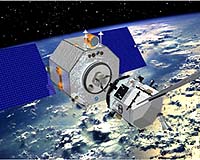
for Science@NASA Huntsville AL (SPX) Mar 06, 2007 It's the year 2020, and space has never been so busy. Picture this: In Earth orbit, a robotic maintenance ship skitters from one weather satellite to another, upgrading powerful optics that help meteorologists track dangerous storms. Four hundred thousand kilometers away, a cargo ferry arrives at the Moon. It spots an orbiting depot, makes its approach and mates flawlessly, offloading drill heads, solar panels and other supplies for a frontier outpost at the Moon's south pole. Meanwhile, down on the the lunar surface, mining buggies trundle along a "sensor highway" between the outpost and some nearby hills. They're harvesting lunar ice hidden in the shadows of a deep, cold crater. Oh yeah - there's not a single human operator in this hypothetical scenario. It's not as far-out as it sounds. All of these spacecraft and satellites, even the mining buggies, could one day operate on their own, guided not by humans but by automated rendezvous and docking technologies now in development by NASA and its partners. Some of those technologies are about to get a field test onboard Orbital Express--a space mission managed by the Defense Advanced Research Projects Agency (DARPA) and a team led by engineers at NASA's Marshall Space Flight Center. Slated for launch this week, March 8, on an Atlas V rocket, Orbital Express will deploy two test satellites: the Autonomous Space Transport Robotic Operations (ASTRO) service vehicle, and the Next-generation serviceable satellite (NextSat). "Our goal is to demonstrate on-orbit refueling, component exchange and satellite repair--all without a human operator," says James Lee, the MSFC Automated Rendezvous and Docking Projects Lead. In a nutshell, ASTRO will dock with NextSat and service it. Who will pilot ASTRO? The answer is not who but what: the Advanced Video Guidance Sensor or AVGS for short. Mounted on ASTRO, the AVGS shoots infrared laser beams, which bounce off a pattern of retroreflectors on NextSat. By analyzing the reflections, ASTRO adjusts its speed and angle of approach to safely close the distance and make contact. Eight test series will be conducted during the three-month mission. ASTRO and NextSat will conduct approach and docking maneuvers from starting points up to 4.3 miles (6.9 km) away. Once docked, they'll also swap propellants and trade and install batteries--the first unassisted component exchange in space history. Tests will be conducted at different times of day to see if darkness on Earth's night side confuses the imaging system. If Orbital Express is a success, use of autonomous rendezvous and docking systems could become a viable alternative to human-piloted missions in the next decade. "Automated systems will take ship-to-ship mating duties off the hands of busy flight crews," says AVGS flight software project leader Keith Cornett of Marshall. "They can solve issues associated with tricky repairs and provide cost-effective options for servicing permanent satellites in orbit around the Moon or Mars." Automated systems could also benefit surface operations, Lee notes, particularly on the airless moon where global positioning systems won't work without relays. That "sensor highway," dotting the surface with reflective markers to shine the way, could one day guide robots from place to place - surveying, sampling and laying the groundwork for human expeditions to come. "When it comes to exploring new worlds, robots can't beat human beings for capturing the experience," Lee says. "But to make those human missions possible, we need to set the stage as completely as we can. Automation is crucial." Community Email This Article Comment On This Article Related Links Orbital Express mission All about the robots on Earth and beyond! All about the robots on Earth and beyond!
 Superbots In Action
 Los Angeles CA (SPX) Mar 05, 2007
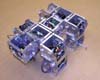
Vivid on-line videos demonstrate Superbot progress USC's lego-like autonomous robotic units show off ability to reconfigure into different systems for different tasks in online .wmv files. Wei-Min Shen of the University of Southern California's Information Sciences Institute recently reported to NASA significant progress in developing "SuperBot," identical modular units that plug into each other to create robots that can stand, crawl, wiggle and even roll. |
|
|

| The content herein, unless otherwise known to be public domain, are Copyright 1995-2006 - SpaceDaily.AFP and UPI Wire Stories are copyright Agence France-Presse and United Press International. ESA PortalReports are copyright European Space Agency. All NASA sourced material is public domain. Additionalcopyrights may apply in whole or part to other bona fide parties. Advertising does not imply endorsement,agreement or approval of any opinions, statements or information provided by SpaceDaily on any Web page published or hosted by SpaceDaily. Privacy Statement |