|
 |
 |
 |
 |
 |
 |
 |
 |

 |
Northern Lights Glimmer With Unexpected Trait
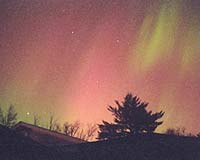
Washington DC (SPX) Apr 30, 2008 An international team of scientists has detected that some of the glow of Earth's aurora is polarized, an unexpected state for such emissions. Measurements of this newfound polarization in the Northern Lights may provide scientists with fresh insights into the composition of Earth's upper atmosphere, the configuration of its magnetic field, and the energies of particles from the Sun, the researchers say. If observed on other planets, the phenomenon might also give clues to the shape of the Sun's magnetic field as it curls around other bodies in the solar system. When a beam of light is polarized, its electromagnetic waves share a common orientation, say, aligned vertically, or at some other angle. Until now, scientists thought that light from energized atoms and molecules in planetary upper atmospheres could not be polarized. The reason is simple: In spite of the low number of particles at the altitudes concerned (above 100 kilometers (60 miles)), there are still numerous collisions between molecules and gas atoms. Those collisions depolarize the emitted light. Fifty years ago, an Australian researcher, Robert Duncan, claimed to observe what looked like polarization of auroral light, but other scientists found that single observation unconvincing. To revisit the question, Jean Lilensten of the Laboratory of Planetology of Grenoble, France, and his colleagues studied auroral light with a custom-made telescope during the winters of 2006-2007 and 2007-2008. They made their observations from Svalbard Island, Norway, which is in the polar region, at a latitude of 79 degrees north. At the north and south magnetic poles, many charged particles in the solar wind--a flow of electrically charged matter from the Sun--are captured by the planet's field and forced to plunge into the atmosphere. The particles strike atmospheric gases, causing light emissions. Lilensten and his colleagues observed weak polarization of a red glow that radiates at an altitude of 220 kilometers (140 miles). The glow results from electrons hitting oxygen atoms. The scientists had suspected that such light might be polarized because Earth's magnetic field at high latitudes funnels the electrons, aligning the angles at which they penetrate the atmosphere. The finding of auroral polarization "opens a new field in planetology," says Lilensten, who is the lead author of the study. He and his colleagues reported their results on 19 April in Geophysical Research Letters, a publication of the American Geophysical Union (AGU). Fluctuations in the polarization measurements can reveal the energy of the particles coming from the Sun when they enter Earth's atmosphere, Lilensten notes. The intensity of the polarization gives clues to the composition of the upper atmosphere, particularly with regard to atomic oxygen. Because polarization is strongest when the telescope points perpendicularly to the magnetic field lines, the measurements also provide a way to determine magnetic field configurations, Lilensten adds. That could prove especially useful as astronomers train their telescopes on other planetary atmospheres. If polarized emissions are observed there as well, the measurements may enable scientists to understand how the Sun's magnetic field is distorted by obstacles such as the planets Venus and Mars, which lack intrinsic magnetic fields. Community Email This Article Comment On This Article Related Links Laboratory of Planetology of Grenoble Solar Science News at SpaceDaily
 Northern Lights Glimmer With Unexpected Trait
 Washington DC (SPX) Apr 28, 2008
An international team of scientists has detected that some of the glow of Earth's aurora is polarized, an unexpected state for such emissions. Measurements of this newfound polarization in the Northern Lights may provide scientists with fresh insights into the composition of Earth's upper atmosphere, the configuration of its magnetic field, and the energies of particles from the Sun, the researchers say. |
|
|

| The content herein, unless otherwise known to be public domain, are Copyright 1995-2007 - SpaceDaily.AFP and UPI Wire Stories are copyright Agence France-Presse and United Press International. ESA Portal Reports are copyright European Space Agency. All NASA sourced material is public domain. Additional copyrights may apply in whole or part to other bona fide parties. Advertising does not imply endorsement,agreement or approval of any opinions, statements or information provided by SpaceDaily on any Web page published or hosted by SpaceDaily. Privacy Statement |