|
 |
 |
 |
 |
 |
 |
 |
 |

 |
Nontraditional Fighter Missions Provide Eyes In The Sky
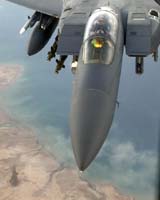
USAF Special to American Forces Press Service Southwest Asia (SPX) Mar 27, 2006 The convoy travels down the dusty desert road. Soldiers keep watchful eyes, surveying the barren landscape surrounding them. Today, their minds are slightly at ease. Overhead, an armed F-16 in direct contact with their team is watching the road ahead. No one will be lost today. The concept of using fighter aircraft with targeting pods to monitor the battlespace is known as nontraditional intelligence, surveillance and reconnaissance. NTISR operations began only four years ago in the U.S. Air Force and are the result of increased demand for complete battlespace awareness, officials said. With the production and development of traditional ISR capabilities such as the unmanned Predator aircraft struggling to keep pace, leveraging fighters, bombers and air-mobility aircraft in a similar role is helping to ensure information dominance. "Before NTISR, we had fighter aircraft with surveillance capabilities burning holes is the sky, just waiting to be tasked by ground commanders," said Maj. Marco Fiorito, deputy chief of collections management at the Combined Air Operations Center here. "Instead of wasting these resources, we've begun to use them to fill some of the gaps in our traditional ISR operations." Central Command Air Forces policy prohibits disclosure of the center's location. NTISR multiplies the commander's capability, without the logistical and financial implications of creating more forces; but that is not its only benefit. "NTISR increases the cross-talk between the Army and the Air Force in joint operations," Fiorito said. "The majority of the time, NTISR aircraft aircrews communicate directly with ground units. This fosters a greater understanding of what ground units are looking for and thinking." This understanding enables air and ground units to work on mutual operational objectives. Most recently, two F-15E Strike Eagles proved the value of this capability during a mortar attack on Balad Air Base, Iraq. The aircraft were called to the scene by the base's Joint Defense Operation Center. Using their electro-optical and infrared sensor capability, they quickly located three insurgents fleeing in a vehicle from the scene. After following the suspects to a house, the aircraft relayed their location to ground forces. All three individuals were successfully detained. "This engagement is an exceptional example of how air forces are contributing to the counterinsurgency campaign," said Royal Air Force Air Commodore Ray Lock, Combined Air Operations Center director. "In this case, we realized the overwhelming advantage we have in the innovative use of fighter aircraft for NTISR." In addition to these capabilities, from a ground perspective, NTISR aircraft are a comfort factor for troops in hostile areas. "These jets are overhead for them," said Fiorito. "These aircraft can scout ahead of convoys, looking for possible ambush sites or any other threat." More importantly, the aircraft can quickly respond to a skirmish or firefight and help the troops on the ground, he added. NTISR also has the potential to be a player in the fight against improvised explosive devices. "We're working around the clock to find a good way of employing NTISR and other assets to the counter-IED fight," said Fiorito. "There are a lot of good people trying to come up with a viable solution." While employing this type of technology is now an everyday practice, Fiorito admits there have been some growing pains. "We're in a unique situation, because we don't want to turn the fighter into an intelligence asset; we just want to get the information to the warfighter in a simplified and quick manner," he said. "Right now we're developing a streamlined process, from beginning to end, that has a single tasking process." The intelligence community, along with ground and operations personnel, is working toward this goal while exploring the effectiveness of NTISR in combat. Admittedly though, it is only one facet of the bigger fight against anti-coalition forces. "If you concentrate on one aspect of warfare, you lose sight of everything else," Fiorito said. "There's no magical solution, you have to hit the enemy at multiple points - counter-IED, ISR and NTISR, convoy support, direct-actions support - all of these pieces make him reel back so he's fighting on your terms, instead of his." Community Email This Article Comment On This Article Related Links US Air Force Read the latest in Military Space Communications Technology at SpaceWar.com
 INX Introduces Emergency And Military Communications Solution
 Dallas TX (SPX) Mar 21, 2006
RouteStep Communications, a division of INX has introduced its FALCoN product, a Forward Area Lightweight Communications Node. Weighing approximately 35 pounds, this complete, Cisco Systems-based, IP communications solution fits in the overhead compartment of an airplane and is easily transported by a single-person. |
|
|

| The content herein, unless otherwise known to be public domain, are Copyright 1995-2006 - SpaceDaily.AFP and UPI Wire Stories are copyright Agence France-Presse and United Press International. ESA PortalReports are copyright European Space Agency. All NASA sourced material is public domain. Additionalcopyrights may apply in whole or part to other bona fide parties. Advertising does not imply endorsement,agreement or approval of any opinions, statements or information provided by SpaceDaily on any Web page published or hosted by SpaceDaily. Privacy Statement |