|
 |
 |
 |
 |
 |
 |
 |
 |

 |
Night Of The Two Moons
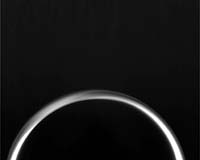
Pasadena CA (JPL) Nov 03, 2004 There was a silver lining to the clouds that blocked Martin Ratcliffe's view of the Oct. 27 lunar eclipse, so the director of Exploration Place, in Wichita, KS, tuned into an eclipse Internet broadcast from Olso, Norway, instead- while also viewing a steady stream of images beamed back from the Cassini-Huygens spacecraft, as it flew by Saturn's moon Titan, on October 27. The Cassini spacecraft took this image of another eclipse as the Sun disappeared behind Saturn's largest moon Titan. "The end of the evening was most memorable," Ratcliffe says. "During the evening, I checked the Cassini raw images site and saw an image I had to display. It was of Titan's atmospheric ring backlit - a view of Titan from its dark side showing the atmosphere lit up as a ring as sunlight shone through it. From Cassini, the sun was eclipsed by Titan. This was coincidentally the same view anyone on [Earth's] Moon would have of Earth if they were on the Moon viewing the eclipse. The Earth would be dark and our atmosphere would glow as an orange ring." "We placed the image of Titan next to the live image of the totally eclipsed Moon," Ratcliffe continues. "It provided a nice visual end to a night of two moons and two eclipses, and, for me, a tingling on the hairs on the back of my neck as I stood and looked at the pair of these images - one from 1.3 billion miles away and one live from Olso." It was a special week for moons in our solar system. The total lunar eclipse was the last one visible from Earth until March 2007. The eclipse was made even more memorable as it presided over the first Boston Red Sox World Series baseball win in 82 years. Will the so-called "Blood Moon" become a part of the rich Red Sox lore? Only time will tell. Meanwhile, the Cassini-Huygens spacecraft made its closest approach yet to Saturn's intriguing Titan, the only moon in our solar system with a thick atmosphere. As Cassini's powerful radar peered through the thick haze surrounding Titan for the first look at the moon's unique surface, other instruments sampled the atmosphere. The science community is abuzz as they begin to interpret a wealth of new information about this strange world orbiting Saturn. Moons are becoming increasingly important scientific targets. Titan's unique atmosphere is intriguing because it may hold clues to how Earth's atmosphere evolved. Jupiter's moons Europa, Ganymede and Callisto are also of intense scientific interest because they all show signs of harboring oceans beneath their icy crusts. If true, the oceans would be the first known beyond Earth. Earth's Moon has always been a source of scientific fascination. New exploration efforts are underway to send astronauts to the Moon and also to evaluate it as a waystation as humanity prepares to journey to Mars and beyond. Back on Earth, both the lunar eclipse and Titan flyby were big news. Seventy-five members of the Cassini-Huygens Saturn Observation Campaign (many of them Solar System Ambassadors as well) gathered with crowds around telescopes and computer screens as two very different moons revealed themselves in magificent splendor. Some dispatches from around the globe: Washington, DC, Geoff Chester, public affairs officer, U.S. Naval Observatory: "We had a special reception and viewing [Oct. 27] for about 75 members of the DC chapter of the U.S. Meteorological Society at the U.S. Naval Observatory. Needless to say, we talked quite a bit about the weather on Titan. Having a reddish Moon in the sky reminded us of the first false-color images of Titan." Dallas, Tex., Bess Amaral, St. Mark's School Planetarium: "I held a lunar eclipse briefing throughout the day in the planetarium and we had great images of Titan thrown in at the end. That night, I had an eclipse watch in the school parking lot. We had a good crowd eyeballing the eclipse as it ducked in and out of clouds. We watched through the telescope to see the shadow cross the craters." Cape Coral, Fla. Carol Stewart, teacher: "I had a small event for the lunar eclipse and talked about Saturn being visible later in the evening as well as how the first images are coming down from Titan. I showed my students the latest images from Titan and explained what scientists are beginning to see. They are impressed with the high quality imaging." Lumbarton, S.C., Ken Brandt, Robeson Planetarium: "We did a lunar eclipse event and even though it was a 'washout,' I made a point of showing some of the tastier Titan flyby images along with a webcast of the eclipse and some animations." Bond Head, Ontario, Canada, Craig Cunningham: "I conducted a lunar eclipse lesson for my daughter's Girl Guides group. It was toward their astronomy badge. I used Cassini info and posters indicating comparisons between our moon and Titan. The sky was perfect for observation." La Paz, El Salvador, Jorge Colorado: "We met in our observatory in San Juan Talpa, a neighborhood of La Paz in El Salvador, Central America. We took some pictures of the eclipse. We had problems during the first contact because the sky was too cloudy, but in the maximum eclipse the clouds disappeared and we enjoyed the spectacular eclipse. Christchurch, New Zealand, Euan Mason: "The eclipse wasn't visible from New Zealand, but we were with you in spirit." Community Email This Article Comment On This Article Related Links Cassini-Huygens mission at JPL SpaceDaily Search SpaceDaily Subscribe To SpaceDaily Express Explore The Ring World of Saturn and her moons Jupiter and its Moons The million outer planets of a star called Sol News Flash at Mercury
 Cassini Images Halo Around Titanic Moon Off Saturn
 Pasadena CA (SPX) Dec 27, 2005
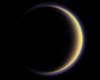
With its thick, distended atmosphere, Titan's orange globe shines softly, encircled by a thin halo of purple light-scattering haze. |
|
|

| The content herein, unless otherwise known to be public domain, are Copyright 1995-2006 - SpaceDaily.AFP and UPI Wire Stories are copyright Agence France-Presse and United Press International. ESA PortalReports are copyright European Space Agency. All NASA sourced material is public domain. Additionalcopyrights may apply in whole or part to other bona fide parties. Advertising does not imply endorsement,agreement or approval of any opinions, statements or information provided by SpaceDaily on any Web page published or hosted by SpaceDaily. Privacy Statement |