|
 |
 |
 |
 |
 |
 |
 |
 |

 |
New Reefs Explored For Pharmaceutical Potential Ecological Impacts
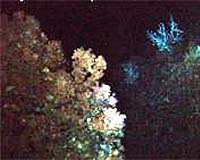
Virginia Key FL (SPX) May 23, 2006 Last December, University of Miami Rosenstiel School of Marine and Atmospheric Science researchers using advanced sonar techniques discovered new deepwater reef sites in the Straits of Florida between Miami and Bimini. The Rosenstiel School scientists will work with Harbor Branch Oceanographic Institution colleagues to explore these areas for the first time. The expedition, which will rely on Harbor Branch's Johnson-Se-Link II submersible, will search for and collect marine organism samples from these new reefs in 2,000-2,900 feet of water to determine which produce chemicals with the potential to treat human diseases such as cancer or Alzheimer's disease. The State of Florida's "Florida Oceans Initiative" is the primary project funder. "The reef raises important issues and questions," said Dr. Mark Grasmueck, a Rosenstiel School professor. "How a reef like this sustains itself without sunlight, without obvious energy and nourishment�it's a unique ecosystem. I find myself putting aside other work to pursue this further as I see this as a once-in-a-lifetime opportunity." Researchers have suspected since the 1970s that deep reefs lay undiscovered between Miami and Bimini because pieces of reef-building corals had been brought up using surface-operated, dredge-and-grab sampling equipment. However, just as the vast majority of the ocean remains poorly mapped and unexplored � even off Miami � these potentially important areas remained unseen. In December 2005, as part of the NOAA Ocean Exploration program, Rosenstiel School researchers, led by Professors Grasmueck and Gregor Eberli, began mapping deepwater habitats off Miami and Bimini using advanced sonar technology and an autonomous underwater vehicle (AUV). AUVs operate without a tether to the surface and are pre-programmed to independently perform tasks. These researchers believe this is the first time an AUV has been used for mapping deepwater coral reefs. AUVs have been frequently used in oil exploration and in a variety of other research programs to accomplish such goals as mapping and collecting and analyzing water samples. Rosenstiel School's December AUV work revealed what appears to be an extensive system of steep walls and mounds as high as 350 feet, all of which are likely to harbor a wide array of sponges, corals, fish and other animals. A camera that Dr. Grasmueck developed allowed the researchers to get an enticing glimpse of the bottom but until researchers make it to the seafloor in the submersible they will not be able to determine the extent and biological diversity of the newly discovered areas. Harbor Branch has discovered a number of other new deepwater reefs in Florida waters in recent years that play important ecological roles but has never before had the chance to explore this area. Starting today, the team will be working at sites on the Bahamas side of the Straits of Florida, about 10 miles from Bimini, and from May 27-30, they will work on the Florida side, beginning about 20 miles out from Miami, though all the reefs are part of the same geological system. After a quick personnel and equipment turnaround, Harbor Branch researchers will return to the Miami area on a separate expedition from May 31 to June 9 to conduct the first in-depth survey of deep reef areas in the region to better assess the ecological importance of the reefs and to learn factors responsible for their incredible diversity. Researchers typically have to spend hours using a ship depth sounder to map an area before determining where to do submersible dives because maps detailed enough to show the telltale mounds and other features of deepwater reefs simply do not exist for the bulk of the seafloor. With such little information available, Grasmueck compared typical seafloor exploration to arriving on the bottom of the Grand Canyon at night with a flashlight and then attempting to ascertain the significance and topography of the whole canyon based on small swaths revealed by the flashlight. The Rosenstiel School AUV work has instead made it possible to choose dive sites likely to be vibrant reef areas, all with an understanding of the full system being explored. The expedition will have two main goals. First the team will use the submersible to explore those seafloor areas that appear most promising based on their sonar map contours. As this andldqo;ground truthing" work progresses, the team will be able to better predict correlations between map data and biodiversity on the bottom. Ultimately, this will allow them to more accurately assess the ecological importance of the entire area, not just those small swaths observed from the submersible. During each submersible dive, Harbor Branch experts will collect samples of organisms such as sponges and corals that they will test to determine if they, or microorganisms living within them, produce chemicals with pharmaceutical potential. A key goal is to find and collect organisms that have never been seen. The team will collect other organisms as well because even well-known species can produce different and potentially important chemicals depending on the depth, temperature, and location at which they are found. Harbor Branch's quest for drugs form the sea began in the early 1980s and has led to the collection of tens of thousands of marine organism samples and the identification of a number of promising potential drugs now in various stages of development for treating cancer, Alzheimer's disease, malaria, AIDS, and other ailments. Community Email This Article Comment On This Article Related Links - Darwin Today At TerraDaily.com
 UN kicks off meeting to better protect world's fishing stocks
 United Nations (AFP) May 22, 2006
 The United Nations on Monday kicked off a four-day conference to review ways of tightening international law to better protect the world's fish stocks which are being depleted by overfishing. |
|
|

| The content herein, unless otherwise known to be public domain, are Copyright 1995-2006 - SpaceDaily.AFP and UPI Wire Stories are copyright Agence France-Presse and United Press International. ESA PortalReports are copyright European Space Agency. All NASA sourced material is public domain. Additionalcopyrights may apply in whole or part to other bona fide parties. Advertising does not imply endorsement,agreement or approval of any opinions, statements or information provided by SpaceDaily on any Web page published or hosted by SpaceDaily. Privacy Statement |