|
 |
 |
 |
 |
 |
 |
 |
 |

 |
UN kicks off meeting to better protect world's fishing stocks
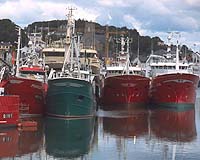
United Nations (AFP) May 22, 2006 The United Nations on Monday kicked off a four-day conference to review ways of tightening international law to better protect the world's fish stocks which are being depleted by overfishing. The meeting at UN headquarters brings together delegates from governments, the fishing industry and environmental groups to review a 1995 agreement for the conservation and management of highly migratory fish stocks. In a report released last week, the Worldwide Fund for Nature (WWF) accused international high seas fishing organisations of failing to prevent over-fishing and its attendant "fish laundering". The document, a study of the world's 16 Regional Fisheries Management Organisations (RFMOs), concluded that the RFMOs, some of which have been operating since the 1920s, "have generally failed to prevent over-exploitation of fish stocks" and have allowed marine eco-systems to decay. Fish launderers use a strategy that is "very hard to trace back", according to Simon Cripps, head of the WWF's maritime programme. They discharge their catch in ports where controls are not too strict, he explains, and then reload it onto other ships sailing under other countries' flags. The Food and Agriculture organization (FAO) estimates that about 25 percent of the stocks it monitors are overexploited, depleted or recovering from depletion. Roughly half of the stocks are fully exploited, producing catches close to their maximum yields, it said, adding that only 25 percent are underexploited or moderately exploited and could maybe produce more. FAO also cited soon-to-be released analyses showing that in the high seas, about 30 percent of the stocks of highly migratory tuna and tuna-like species, more than 50 percent of highly migratory oceanic sharks and nearly two-thirds of straddling stocks and other high seas stocks are overexploited or depleted. Speaking in his capacity as chair of the Pacific Islands Forum, Papua New Guinea's (PNG) UN Ambassador Robert Aisi stressed the need for the conference to address the issue of illegal, unregulated and unreported (IUU) fishing. "No single issue has the potential for greater ongoing impact on our livelihoods than this one," he noted. "We must strengthen regulatory measures, extend coverage of regional organizations and improve our enforcement capabilities to fight IUU capabilities that gravely endanger the future of our fish resources. Despite a voluntary code of conduct for responsible fisheries adopted by FAO members in 1995 and a 2001 action plan to address the problem, some fishers do not respect rules concerning fishing gear and fishing areas while others fail to report or misreport their catches. Members of the Pacific Islands Forum include Australia, Federated States of Micronesia, Fiji, Kiribati, the Marshall Islands, Nauru, New Zealand, Palau, PNG, Samoa, Solomon Islands, Tonga, Tuvalu and Vanuatu. Community Email This Article Comment On This Article Related Links Darwin Today At TerraDaily.com
 Putting The Puzzle Of Life Together
 Uniontown PA (SPX) May 22, 2006
Two laboratories at Penn State set out to show how an obscure undersea microbe metabolizes carbon monoxide into methane and vinegar. What they found was not merely a previously unknown biochemical process--their discovery also became the inspiration for a fundamental new theory of the origin of life on Earth, reconciling a long-contentious pair of prevailing theories. |
|
|

| The content herein, unless otherwise known to be public domain, are Copyright 1995-2006 - SpaceDaily.AFP and UPI Wire Stories are copyright Agence France-Presse and United Press International. ESA PortalReports are copyright European Space Agency. All NASA sourced material is public domain. Additionalcopyrights may apply in whole or part to other bona fide parties. Advertising does not imply endorsement,agreement or approval of any opinions, statements or information provided by SpaceDaily on any Web page published or hosted by SpaceDaily. Privacy Statement |