|
 |
 |
 |
 |
 |
 |
 |
 |

 |
New Progress To Launch To Space Station
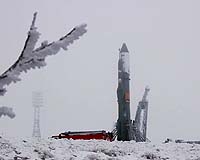
Baikonur, Kazakhstan (SPX) Jan 18, 2007 A new Progress is scheduled to launch to the International Space Station a little after 9 p.m. EST Wednesday, Jan. 17, with more than 2.5 tons of fuel, oxygen, other supplies and equipment aboard. The station's 24th Progress unpiloted cargo carrier will bring to the orbiting laboratory more than 1,720 pounds of propellant, about 110 pounds of oxygen, and 3,285 pounds of dry cargo - a total of 5,115 pounds. P24 will launch from the Baikonur Cosmodrome in Kazakhstan. It is scheduled to reach the station after a flight of just over two days. Docking is to be on Friday, Jan. 19 a little after 10 p.m. The spacecraft will use the automated Kurs system to dock at the Pirs Docking Compartment. Expedition 14 flight engineer Mikhail Tyurin will stand by at the manual Toru docking system controls, should his intervention become necessary. Expedition 14 crew members, Commander Mike Lopez-Alegria, Tyurin and Flight Engineer Sunita Williams, finished filling P24's sister cargo carrier, ISS Progress 22, with trash and other discards for its Jan. 16 undocking from Pirs and subsequent destruction on re-entry. After its unloading, P22 was used as a storage area for a while. Many items brought to the station aboard the space shuttle Discovery on STS-121 in July eventually found a temporary home there until crew members could put them in more permanent places. ISS Progress 23 remains at the aft compartment of the Zvezda Service Module. It is scheduled to undock in April. The Progress is similar in appearance and some design elements to the Soyuz spacecraft, which brings crew members to the station, serves as a lifeboat while they are there and returns them to Earth. The aft module, the instrumentation and propulsion module, is nearly identical. But the second of the three Progress sections is a refueling module, and the third, uppermost as the Progress sits on the launch pad, is a cargo module. On the Soyuz, the descent module, where the crew is seated on launch and which returns them to Earth, is the middle module and the third is called the orbital module.
earlier related report "The ship was undocked from the ISS in normal mode," the spokesman said. The spokesman said fragments of the Russian spaceship that failed to burn up in the Earth's atmosphere sank in the Pacific Ocean at 6.15 a.m. Moscow time (3.15 a.m. GMT) some 3,900 km (2,420 miles) southeast of Wellington, New Zealand. The so-called "spaceship cemetery," located not far from Christmas Island, is a designated area where many spacecraft, including the defunct Mir station, have been sunk.
Source: RIA Novosti Community Email This Article Comment On This Article Related Links Progress at NASA Progress at Energia Space Station News at Space-Travel.Com Space Station News at Space-Travel.Com
 ISS Turns Into Spaceport Full Of Plants And Labs
 Moscow (SPX) Jan 18, 2007
Research and industrial facilities will emerge based on the International Space Station (ISS), RIA Novosti reported referring to Nikolay Sevastianov, chief of RSC Energia. |
|
|

| The content herein, unless otherwise known to be public domain, are Copyright 1995-2006 - SpaceDaily.AFP and UPI Wire Stories are copyright Agence France-Presse and United Press International. ESA PortalReports are copyright European Space Agency. All NASA sourced material is public domain. Additionalcopyrights may apply in whole or part to other bona fide parties. Advertising does not imply endorsement,agreement or approval of any opinions, statements or information provided by SpaceDaily on any Web page published or hosted by SpaceDaily. Privacy Statement |