|
 |
 |
 |
 |
 |
 |
 |
 |

 |
New Human Species Found On Indonesian island of Flores
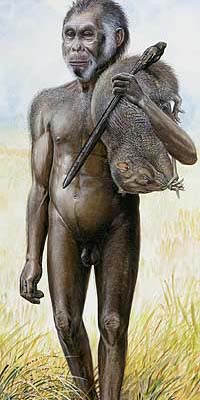
Paris (AFP) Oct 28, 2004 In one of the most spectacular fossil finds in decades, anthropologists are to announce on Thursday they have found the bones of a tiny human who may have been a twig in mankind's family tree. The height of a chimpanzee and with a skull the size of a grapefruit, the wee hominid lived around 18 000 years ago on the remote eastern Indonesian island of Flores, they say. He is believed to be an extinct Asian offshoot of Homo erectus, the forerunners of Homo sapiens, as anatomically modern man is called. But he was so dramatically different from either H erectus or H sapiens that he should be classified as a separate species of Homo, said the team report on Thursday in the British weekly scientific journal Nature. He measured just a metre or so high and had a brain size of 380cc, just a quarter of modern human being's. They have dubbed the hominid Homo floresiensis, "Man of Flores". He is the smallest of the 10 known species of the genus Homo, the hominid that arose out of Africa about 2,5 million years ago. Their theory, based on the previous discovery of stone tools on Flores, is that H. erectus arrived on Flores about 800 000 years ago and became genetically marooned from the rest of mankind. Over thousands of years, evolutionary pressure caused the colony to shrink in height - paucity of food and over-population favoured the survival of smaller individuals, whose genes were then passed onto their infants. "We interpret H. floresiensis as a relict lineage 1/8of Homo 3/8 that reached, and was then preserved on, a Wallacean island refuge," say the authors, led by Peter Brown of University New England in Australia. "In isolation, these populations underwent protacted, endemic change." As the millennia passed, Homo erectus petered out in the rest of the world, to be replaced by taller hominids with bigger brains. The most successful was H. sapiens, which strode out of Africa about 150 000 years ago and eventually conquered the planet, becoming the only living species of Homo today. H. sapiens migrated across southern Asia between 100 000 and 50 000 years ago, according to a conventional scenario. He then forked north-east, crossing over into the Americas via island stepping-stones to Alaska, and also south-east, to colonise the Indonesian archipelago, the South Pacific, Australia and New Zealand, according to a popular scenario. So at some point, H. sapiens also showed up on Flores - possibly living there for tens of thousand years alongside H. floriensis. What happened then is one of the big unanswerable questions, says Brown's team. It is impossible to know how the two species interacted. Did H. sapiens slaughter its smaller neighbours? Or did H. floresiensis eventually become extinct because it could no longer compete for food against its bigger cousins? Another question is whether the two species may have interbred, possibly adding to the genetic mix that is H. sapiens today. That puzzle also applies to the Neanderthals, the hominids who lived in Europe, parts of Central Asia and the Middle East for about 170 000 years until they inexplicably disappeared around 28 000-30 000 years ago. "The find is startling... among the most outstanding discoveries in palaeo-anthropology for half a century," University of Cambridge anthropologists Marta Mirazon Lahr and Robert Foley said in a commentary, also carried in Nature. "It is breathtaking to think that such a different species 1/8of hominid 3/8 existed so recently," they said. "Our global dominance may be far more recent than we thought." The Flores discovery includes the skull, femur and tibia, hand fragments and bits of vertebrae from one individual, apparently a female, and a premolar from another. They were unearthed from the floor of a cave at Liang Bua, in the middle of western Flores, where amateur anthropologists first started excavating in 1965. The authors are certain that the skeleton, called LB1, is that of a full-grown adult human, not a dwarf H. sapiens or an ape. Islands are famous for Darwinian selection, for shaping the genetic path of species through climate, terrain and food availability and lack of breeding with other species. Flores was once the home of a dwarf elephant called a Stegodon, the remains of which were found alongside the H. floriensis fossils. Also found there were sharp and pointed bones that may have been tools, but it is debatable as to whether these were made by H. floresiensis or by H. sapiens. Community Email This Article Comment On This Article Related Links SpaceDaily Search SpaceDaily Subscribe To SpaceDaily Express Dirt, rocks and all the stuff we stand on firmly
 Magnetic Reconnection Region Larger Than 2.5 Million Km Found In The Solar Wind
 Paris (ESA) Jan 12, 2006
Using the ESA Cluster spacecraft and the NASA Wind and ACE satellites, a team of American and European scientists have discovered the largest jets of particles created between the Earth and the Sun by magnetic reconnection. This result makes the cover of this week's issue of Nature. |
|
|

| The content herein, unless otherwise known to be public domain, are Copyright 1995-2006 - SpaceDaily.AFP and UPI Wire Stories are copyright Agence France-Presse and United Press International. ESA PortalReports are copyright European Space Agency. All NASA sourced material is public domain. Additionalcopyrights may apply in whole or part to other bona fide parties. Advertising does not imply endorsement,agreement or approval of any opinions, statements or information provided by SpaceDaily on any Web page published or hosted by SpaceDaily. Privacy Statement |