|
 |
 |
 |
 |
 |
 |
 |
 |

 |
Negative Vibes From Space
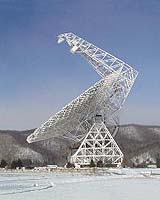
Cambridge MA (SPX) Dec 05, 2006 Astronomers have discovered the first negatively charged molecule in space, identifying it from radio signals that were a mystery until now. While about 130 neutral and 14 positively charged molecules are known to exist in interstellar space, this is the first negative molecule, or anion, to be found. "We've spotted a rare and exotic species, like the white tiger of space," said astronomer Michael McCarthy of the Harvard-Smithsonian Center for Astrophysics (CfA). By learning more about the rich broth of chemicals found in interstellar space, astronomers hope to explain how the young Earth converted these basic ingredients into the essential chemicals for life. This new finding helps to advance scientists' understanding of the chemistry of the interstellar medium, and hence the birthplaces of planets. McCarthy worked with CfA colleagues Carl Gottlieb, Harshal Gupta (also from the Univ. of Texas), and Patrick Thaddeus to identify the molecular anion known as C6H-: a linear chain of six carbon atoms with one hydrogen atom at the end and an "extra" electron. Such molecules were thought to be extremely rare because ultraviolet light that suffuses space easily knocks electrons off molecules. The large size of C6H-, larger than most neutral and all positive molecules known in space, may increase its stability in the harsh cosmic environment. "The discovery of C6H- resolves a long-standing enigma in astrochemistry: the apparent lack of negatively charged molecules in space," stated Thaddeus. The team first conducted laboratory experiments to determine exactly what radio frequencies to use in their search. Then, they used the National Science Foundation's Robert C. Byrd Green Bank Telescope to hunt for C6H- in celestial objects. In particular, they targeted locations in which previous searches had spotted unidentified radio signals at the appropriate frequencies. They found C6H- in two very different locations-a shell of gas surrounding the evolved red giant star IRC +10216 in the constellation Leo, and the cold molecular cloud TMC-1 in Taurus. The presence of the anion in both regions shows that the chemical processes that form C6H- are ubiquitous. It also suggests that other molecular anions are present and will be found in the near future. "This finding is dramatic evidence that our understanding of interstellar chemistry is still quite rudimentary. It also implies that more molecular anions, perhaps many, may now be found in the laboratory and in space," said McCarthy. This research will appear in the December 1 issue of The Astrophysical Journal Letters. Community Email This Article Comment On This Article Related Links Harvard-Smithsonian Center for Astrophysics Stellar Chemistry, The Universe And All Within It Stellar Chemistry, The Universe And All Within It
 Dark Matter Hides, Physicists Seek
 Stanford CA (SPX) Dec 01, 2006
Scientists don't know what dark matter is, but they know it's all over the universe. Everything humans observe in the heavens-galaxies, stars, planets and the rest-makes up only 4 percent of the universe, scientists say. The remaining 96 percent is composed of dark matter and its even more mysterious sibling, dark energy. |
|
|

| The content herein, unless otherwise known to be public domain, are Copyright 1995-2006 - SpaceDaily.AFP and UPI Wire Stories are copyright Agence France-Presse and United Press International. ESA PortalReports are copyright European Space Agency. All NASA sourced material is public domain. Additionalcopyrights may apply in whole or part to other bona fide parties. Advertising does not imply endorsement,agreement or approval of any opinions, statements or information provided by SpaceDaily on any Web page published or hosted by SpaceDaily. Privacy Statement |