|
 |
 |
 |
 |
 |
 |
 |
 |

 |
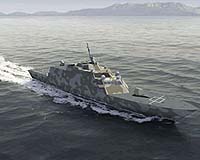
Navy To Base First Four Littoral Combat Ships In San Diego
Washington DC (NNS) May 10, 2006 The Navy announced April 27 that the first four Littoral Combat Ships (LCS) will be homeported at Naval Station San Diego, Calif. Key in the success of implementing these new concepts is the ability to colocate these ships to achieve readiness alignment and economy of scale. This colocation is especially important for the first ships in the class as waterfront facilities, infrastructure, training and maintenance efficiencies are developed. San Diego was chosen as the initial homeport because of the Navy's increased emphasis on the Pacific theater based on the Quadrennial Defense Review. "Homeporting the first four ships in San Diego will enable us to establish synergy between the ships and with local commands," said Vice Adm. Terry Etnyre, commander, Naval Surface Forces, based in Coronado, Calif. "With the Undersea Warfare Command here in San Diego and the Mine Warfare Command moving here soon, the undersea warfare and mine warfare mission packages will have direct coordination and representation locally." LCS will carry some core capabilities such as self-defense and command and control, but its true war-fighting capability will come from its innovative and tailored mission modules. These ships will be configured for one mission package at a time, consisting of modules, manned aircraft, unmanned vehicles, off-board sensors, and mission-manning detachments. This will operate within open-systems architecture, giving it the capability to reconfigure mission modules and ship systems to tailor it for specific warfighting missions. The Littoral Combat Ships are the first Navy vessels to separate capability from hull form and provide a robust, affordable, mission-focused warship designed to provide assured access for our joint forces. LCS will have the size, speed, endurance, and connectivity to deploy as a member of carrier strike groups, expeditionary strike groups or surface strike groups. The innovative concepts in LCS do not end with its modularity. LCS will operate with a quarter of the crew normally assigned to ships this size through a combination of technology and process improvements for maintenance, logistics, training and administration. The keel for the first Littoral Combat Ship, to be named USS Freedom (LCS 1), was laid June 3, 2005, and the second, to be named USS Independence (LCS 2), Jan. 19, 2006. Community Email This Article Comment On This Article Related Links - Naval Warfare in the 21st Century
 Ring of Steel Encircles Iraqi Oil Platforms
 Persian Gulf (SPX) May 02, 2006
There's a "ring of steel" around one of the most important economic targets in the world. That's the way Royal Navy Cmdr. Steve Dainton, the captain of HMS St. Albans, described the coalition maritime protection around Iraqi oil terminals in the Northern Arabian Gulf. |
|
|

| The content herein, unless otherwise known to be public domain, are Copyright 1995-2006 - SpaceDaily.AFP and UPI Wire Stories are copyright Agence France-Presse and United Press International. ESA PortalReports are copyright European Space Agency. All NASA sourced material is public domain. Additionalcopyrights may apply in whole or part to other bona fide parties. Advertising does not imply endorsement,agreement or approval of any opinions, statements or information provided by SpaceDaily on any Web page published or hosted by SpaceDaily. Privacy Statement |