|
 |
 |
 |
 |
 |
 |
 |
 |

 |
Ring of Steel Encircles Iraqi Oil Platforms
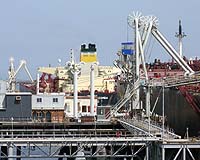
for American Forces Press Service Persian Gulf (SPX) May 02, 2006 There's a "ring of steel" around one of the most important economic targets in the world. That's the way Royal Navy Cmdr. Steve Dainton, the captain of HMS St. Albans, described the coalition maritime protection around Iraqi oil terminals in the Northern Arabian Gulf. The terminals generate some $18,000 a second for Iraq as they pump crude oil into four supertankers gathered around the Al Basra Oil Terminal and two smaller tankers around the Khawr al Amaya Oil Terminal. The terminals operate around the clock. A line of tankers vanishes over the horizon further south as they wait their turn at the pump. The two platforms are known as ABOT and KAOT. Coalition maritime forces guard the platforms from attack. On KMOT is a memorial to three Americans killed in the attack on it two years ago. On April 24, 2004, an American boat stopped a dhow attempting to penetrate the exclusion zone around the platforms. The dhow exploded as the crew boarded it, killing two U.S. sailors and a Coast Guardsman. Other dhows, similarly booby-trapped, attempted to break the ring of steel, but coalition forces dealt with them. Through it all, the platforms kept pumping. The loss of the platforms could be catastrophic not only to Iraq - which generates more than 80 percent of its revenue through the oil terminals - but also to the world. "Bottom line, this oil is their future," said Navy Capt. Christopher Noble, commander of Coalition Task Group 58.1, the group primarily charged with defending the platforms. "Without the hard currency, without the economic anchor, it's going to be very difficult for Iraq. We take (the responsibility) very seriously." Iraqi patrol boats and marines have joined the coalition protecting the oil platforms, and are now an integral part of the platform defenses. Iraqi marines man defenses on the platforms and Iraqi patrol boats sail alongside coalition ships. "They have just been aces," said Marine Brig. Gen. Carl B. Jensen, the commander of Coalition Task Force 58. "They are highly motivated, they take enormous pride in what they are doing and the fact that they are defending their home turf. These are their waters, these are their oil platforms, and they understand fully the priceless value that these oil platforms represent to their nation." The coalition forces continue to work with the Iraqi servicemembers to train them up both at sea and at the home base in Umm Qasr. A U.S. Navy transition team does the training in Umm Qasr, and the task force commander certifies the forces. "I expected much more difficulty with language and cultural barriers, but they haven't materialized," Noble said. "There have been some, but we are able to work through those." All countries recognize the importance of the oil platforms and the coalition constantly includes ships from the United States, Great Britain and Australia. Ships from other countries shuttle in and out of the command. "The world realizes the importance of the team here and how necessary it is to stability and to set the conditions for economic development," said Royal Australian Navy Cmdr. Mal Wise, the captain of the HMAS Ballarat. The coalition has a "defense in depth" for the platforms, Jensen said. Iraqi marines and U.S. sailors from Mobile Security Detachment 71 from Guam man defenses on the platforms themselves. Coalition ships and helicopters provide the muscle for the ring of steel. Further afield there are roving patrols and Jensen can call on other assets from the U.S. Navy's Carrier Group 7 or land-based personnel. "This is not unlike protecting a nuclear power station in the states," Jensen said. "They are guarded and guarded very well because the prospect of them being destroyed is too horrible to imagine. It's the same here." And the ring of steel maintains its edge and mission. "Every morning we get up, we see the oil platforms are still there, and we know we've achieved our mission for another 24 hours," Dainton said. "We have to maintain our focus." Community Email This Article Comment On This Article Related Links U.S. Naval Forces Central Command Naval Warfare in the 21st Century
 Work Begins On First Franco-Spanish Scorpene Submarine For India
 Cherbourg, France (AFP) May 01, 2006
France's state shipbuilder DCN began Friday manufacturing parts for the first of six Scorpene submarines ordered by India. New Delhi agreed in October 2005 to buy six of the Franco-Spanish submarines for 2.4 billion euros (three billion dollars). |
|
|

| The content herein, unless otherwise known to be public domain, are Copyright 1995-2006 - SpaceDaily.AFP and UPI Wire Stories are copyright Agence France-Presse and United Press International. ESA PortalReports are copyright European Space Agency. All NASA sourced material is public domain. Additionalcopyrights may apply in whole or part to other bona fide parties. Advertising does not imply endorsement,agreement or approval of any opinions, statements or information provided by SpaceDaily on any Web page published or hosted by SpaceDaily. Privacy Statement |