|
 |
 |
 |
 |
 |
 |
 |
 |

 |
Nanoassembly Technique Draws On Lessons From Cell Membranes
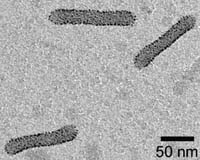
Houston TX (SPX) Nov 28, 2006 Chemists at Rice University have discovered how to assemble gold and silver nanoparticle building blocks into larger structures based on a novel method that harkens back to one of nature's oldest known chemical innovations - the self-assembly of lipid membranes that surround every living cell. The research appears in the Nov. 29 issue of the Journal of the American Chemical Society. Researchers believe the new method will allow them to create a wide variety of useful materials, including extra-potent cancer drugs and more efficient catalysts for the chemical industry. The method makes use of the hydrophobic effect, a biochemical phenomena that all living creatures use to create membranes, ultra-thin barriers of fatty acids that form a strong yet dynamic sack around the cell, sealing it from the outside world. Cell membranes are one example of a micelle, a strong bilayer covering that is made of two sheets of lipid-based amphiphiles, molecules that have a water-loving, or hydrophilic, end, and a water-hating, or hydrophobic, end. Like two pieces of cellophane tape being brought together, the hydrophobic sides of the amphiphilic sheets stick to one another, forming the bilayered micelle. "When the micelle forms, the process drives the packing of all the junction points, which connect the hydrophobic and the hydrophilic part of an amphiphile, into a high-density array," said Eugene Zubarev, the Norman Hackerman-Welch Young Investigator and assistant professor of chemistry. "By attaching a nanoparticle to the junction point of an amphiphile, we can, in effect, use micellization as a means to assemble billions and billions of individual nanoparticles into well-defined one-dimensional superstructures that are soluble in water." Zubarev and colleagues synthesized V-shaped amphiphiles of polystyrene-b-poly(ethylene oxide) and attached two-nanometer diameter gold particles at the focal point of the V. Upon adding water and inducing micelle formation, the team found it could create tightly packed cylinders of gold nanoparticles measuring just 18 nanometers in diameter. All micelles form in three allowable shapes - spheres, cylinders and sack-like vesicles. By varying the length of the polystyrene arm, the solvents used and the size of the gold particles, Zubarev and colleagues were able to form spheres, vesicles and vary the diameter of their cylinders, some of which grew to well-over 1,000 nanometers in length. "We believe further manipulation of these parameters may provide an opportunity to control the optical and catalytic properties of these nanoassemblies," Zubarev said. Community Email This Article Comment On This Article Related Links Rice University Nano Technology News From SpaceMart.com Nano Technology News From SpaceMart.com Computer Chip Architecture, Technology and Manufacture
 NASA Works With ISM To Commercialise Nanotube Technology
 Boston MA (SPX) Nov 10, 2006
As researchers gather for the National Nano Engineering Conference in Boston November 9-10, they will have the opportunity to learn about how a NASA-developed innovative process is making a big impact in nanotechnology. |
|
|

| The content herein, unless otherwise known to be public domain, are Copyright 1995-2006 - SpaceDaily.AFP and UPI Wire Stories are copyright Agence France-Presse and United Press International. ESA PortalReports are copyright European Space Agency. All NASA sourced material is public domain. Additionalcopyrights may apply in whole or part to other bona fide parties. Advertising does not imply endorsement,agreement or approval of any opinions, statements or information provided by SpaceDaily on any Web page published or hosted by SpaceDaily. Privacy Statement |