|
 |
 |
 |
 |
 |
 |
 |
 |

 |
NASA Selects Jupiter Mission Candidate For Further Study
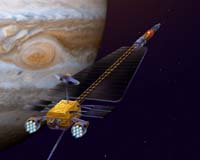
San Antonio TX (SPX) Aug 05, 2004 Two science instruments to be developed by Southwest Research Institute (SwRI) are part of a proposal selected by NASA as a candidate for the next mission in the agency's New Frontiers Program. The two mission proposals selected by NASA for further study are to orbit Jupiter from pole to pole for the first time to conduct an in-depth study of the giant planet and to drop robotic landers into a crater at the south pole of the Moon and return samples to Earth. The SwRI instruments, JADE (Jovian Auroral Distributions Experiment) and Alice, are part of the proposed "Juno" mission to orbit Jupiter. "The Juno mission will provide the critical information needed to understand how the solar system's largest planet, Jupiter, formed several billion years ago and how it interacts with the solar wind even today," says Dr. David J. McComas, senior executive director of the SwRI Space Science and Engineering Division. JADE is designed to measure the auroral electron and ion populations along the planet's magnetic field lines and determine what particle populations create the jovian aurora. "The JADE experiment allows us to make the first direct measurements of the particles that create Jupiter's stunning auroral displays," says McComas, who serves as JADE principal investigator and has overall responsibility for the SwRI contribution. The Alice instrument is designed to image ultraviolet emissions from the jovian aurora, which will allow space scientists to relate these auroral observations with JADE observations of the particle populations that create them. "The Alice instrument on Juno will provide Hubble-like images of Jupiter's powerful and dynamic aurora, but from the much better vantage points of directly above the north and south poles," says Dr. G. Randall Gladstone, an Institute scientist at SwRI who serves as Alice principal investigator. The Alice instrument is similar to instruments of the same name flying on the European Space Agency's Rosetta comet orbiter and scheduled for flight on NASA's New Horizons mission to Pluto. The Juno team proposes using a highly instrumented spacecraft placed in a polar orbit around Jupiter to investigate the existence of an ice-rock core, determine the global water and ammonia abundances in Jupiter's atmosphere, study convection and deep wind profiles in the atmosphere, investigate the origin of the jovian magnetic field and explore the polar magnetosphere. Dr. Scott Bolton of the Jet Propulsion Laboratory leads the overall investigation. The other proposal selected by NASA for further study is "Moonrise: Lunar South Pole - Aitken Basin Sample Return Mission," led by Dr. Michael Duke of the Colorado School of Mines. This team proposes to land two identical landers on the surface near the Moon's south pole and return to Earth approximately five pounds of lunar materials from a region of the Moon's surface believed to harbor materials from its mantle. Each proposal team now receives up to $1.2 million to conduct a seven-month feasibility study focused on cost, management and technical plans. NASA expects to select one of the mission proposals for full development in May 2005 as the second New Frontiers mission, for a June 2009 launch. The first mission selected by NASA in the New Frontiers Program is New Horizons, which will examine the Pluto-Charon system in 2014 and later target a Kuiper belt object. SwRI manages the New Horizons science investigation for NASA. The spacecraft is currently under construction and is scheduled for a January 2006 launch. Community Email This Article Comment On This Article Related Links Southwest Research Institute Missions at NASA SpaceDaily Search SpaceDaily Subscribe To SpaceDaily Express Launch Pad at Space-Travel.com
 Soyuz To Launch Radarsat-2
 Evry, France (SPX) Jan 11, 2006
Starsem announced Monday the signing of a contract with MacDonald, Dettwiler and Associates (MDA) for the launch of MDA's RADARSAT-2 Earth observation satellite by a Soyuz launch vehicle. |
|
|

| The content herein, unless otherwise known to be public domain, are Copyright 1995-2006 - SpaceDaily.AFP and UPI Wire Stories are copyright Agence France-Presse and United Press International. ESA PortalReports are copyright European Space Agency. All NASA sourced material is public domain. Additionalcopyrights may apply in whole or part to other bona fide parties. Advertising does not imply endorsement,agreement or approval of any opinions, statements or information provided by SpaceDaily on any Web page published or hosted by SpaceDaily. Privacy Statement |