|
 |
 |
 |
 |
 |
 |
 |
 |

 |
NASA Orbiter Reveals New Details Of Mars Both Young And Old
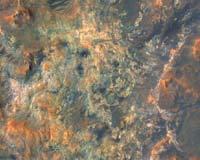
Pasadena CA (SPX) Oct 17, 2006 During its first week of observations from low orbit, NASA's newest Mars spacecraft is already revealing new clues about both recent and ancient environments on the red planet. Scientists hope the Mars Reconnaissance Orbiter will answer questions about the history and distribution of Mars' water by combining data from the orbiter's high-resolution camera, imaging spectrometer, context camera, ground-penetrating radar, atmospheric sounder, global color camera, radio and accelerometers. Between Sept. 29 and Oct. 6, science instruments on the spacecraft viewed dozens of sites that reflect different episodes in Mars' history. The diverse sites provide a good test for the capabilities of the spacecraft instruments. The orbiter will begin its primary science mission phase in early November when Mars re-emerges from passing nearly behind the sun. The instruments are seeing details in the shapes and icy composition of geologically young layering near the Martian north pole. Other views offer details of a mid-latitude valley whose upper layers have been eroded away, revealing an underlying clay layer that formed a few billion years ago, when wet conditions produced the clay. Observations of a southern-hemisphere crater show fine-scale details of more recent gullies, adding evidence that they were carved by flowing water. "In this opening phase we have tested the instruments, and they are working perfectly," said Dr. Steve Saunders, Mars Reconnaissance Orbiter program scientist at NASA Headquarters, Washington. "The teams are getting amazing science data. They are ready to fulfill the mission's science objectives and to support other Mars missions. One image is already helping the Mars Exploration Rover team choose a route to explore Victoria Crater. Others will help guide the selection of a safe site for the future Phoenix Mars Lander." In Chasma Boreale, a vast valley that juts into the north polar ice cap, the orbiter's spectrometer sees layers that vary in soil composition and in how much ice is mixed with the soil. A dark underlying layer contains little ice, but just beneath it lies ice-rich material resembling higher layers. The spectrometer takes pictures both in visible-light and infrared wavelengths useful for identifying what a target is made of. "You see more-ice-rich and less-ice-rich layers, which tells you that conditions changed from the time one layer was deposited to the time another layer was deposited," said Dr. Scott Murchie of Johns Hopkins University Applied Physics Laboratory, Laurel, Md. Murchie is the principal investigator for the spectrometer on the spacecraft. "These layers are geologically young -- on the order of thousands or millions of years -- and may hold clues about climate cycles." A lower-latitude target was Mawrth Vallis. The European Mars Express spacecraft previously discovered ancient deposits of clay minerals that could form only if water were present for a long time at Mawrth Vallis. The Mars Reconnaissance Orbiter's spectrometer has resolved smaller-scale compositional features and detected differing clay mineral content. The clay-rich areas show some of the best evidence for conditions possibly favorable for life on ancient Mars, Murchie said. The mission's High Resolution Imaging Science Experiment camera has shown unprecedented detail in orbital images of Mars. An example was released recently showing the Opportunity rover at Victoria Crater. The camera imaged 64 areas on Mars during the testing week. "These images are truly beautiful, and since they resolve features the size of people, you can visualize yourself hiking around in these diverse terrains," said the camera's principal investigator, Dr. Alfred McEwen of the University of Arizona, Tucson. The high-resolution camera, the imaging spectrometer and the orbiter's wider-looking Context Camera all observed Mawrth Vallis. Details visible in the new observations, such as small channels, are consistent with past wet conditions, McEwen said. Another observation of an unnamed southern crater shows relatively young gullies, like those seen in many Mars locations viewed by NASA's Mars Global Surveyor orbiter. Braided channels characteristic of sediment-rich streams are visible in the new observations. This reinforces the interpretation that these geologically young gullies formed at least in part from erosion by flowing water. Original discovery of the many geologically young gullies on Martian slopes was by Dr. Michael Malin of Malin Space Science Systems, San Diego. Community Email This Article Comment On This Article Related Links Mars Reconnaissance Orbiter HiRoc at Arizona CRISM at APL Mars News and Information at MarsDaily.com Mars News and Information at MarsDaily.com Lunar Dreams and more
 The View From A Promontory Call Cape Verde At Victoria Crater
 Pasadena CA (JPL) Oct 17, 2006
Opportunity is healthy and perched at the tip of the promontory "Cape Verde," 3.1 meters (10.2 feet) from the edge of a sharp drop off on the rim of "Victoria Crater." Soon after arriving at Victoria Crater's "Duck Bay" last week, Opportunity was sent on its way to Cape Verde. Six sols, four drives and 127.61 meters (419 feet) later, Opportunity arrived at the rock target "Fogo" near the tip of Cape Verde. |
|
|

| The content herein, unless otherwise known to be public domain, are Copyright 1995-2006 - SpaceDaily.AFP and UPI Wire Stories are copyright Agence France-Presse and United Press International. ESA PortalReports are copyright European Space Agency. All NASA sourced material is public domain. Additionalcopyrights may apply in whole or part to other bona fide parties. Advertising does not imply endorsement,agreement or approval of any opinions, statements or information provided by SpaceDaily on any Web page published or hosted by SpaceDaily. Privacy Statement |