Energy News  
NASA, NSBRI Select 17 Proposals In Space Radiation Research

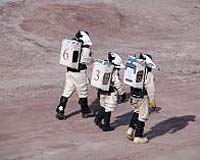
File image.
by Staff Writers
Washington DC (SPX) Sep 26, 2007
The crews of future missions to the moon and Mars could face serious health risks from exposure to space radiation. NASA and the National Space Biomedical Research Institute, known as NSBRI, Houston, will fund 17 new research projects that will enable NASA to better understand and reduce those risks. Scientists at universities, research institutions and private companies in eight states will conduct the studies.

The goal of NASA's space radiation research is to enable the human exploration of space by understanding and limiting astronaut health risks from space radiation. The health risks of radiation during space travel may include cancer, acute radiation sickness and degenerative tissue damage, including damage to the central nervous system. The new research is designed to deliver products that will help in the development of effective shielding or biological countermeasures for radiation exposure.

The 17 projects were selected from 98 proposals received in response to a NASA and NSBRI announcement, Ground-Based Studies in Space Radiation. Scientific and technical experts from academia and government laboratories reviewed the proposals. The total potential value of the selected proposals is about $15 million.

NSBRI is a NASA-funded consortium of institutions studying the health risks related to long-duration spaceflight. The institute's science, technology and education projects take place at more than 70 institutions across the United States.

Selected principal investigators, their organization and their proposal title for NASA awards are:

- Jeff Bacher, Promega Corp., A Novel Biodosimetry Method
- Janet Baulch, University of Maryland, Dose Rate Effects on the Mechanisms of Space Radiation-Induced Delayed Genomic Instability
- Joel Bedford, Colorado State University, Dose-Rate Effects and Components of Systems Governing Variations in Susceptibility for Carcinogenic and Acute Radiation Risks Following Gamma-Ray, Proton, or HZE Irradiation
- Eleanor Blakely, Lawrence Berkeley National Laboratory, Early Markers of Space Radiation-Induced Human Cataractogenesis
- Polly Chang, SRI International, Tissue-Specific Acute and Late Molecular Surveillance of Particle Radiation Effects
- Benjamin Chen, University of Texas Southwestern Medical Center, The Impact of HZE Particles on Adult Neural Stem Cells and Neurogenesis
- Michael Comforth, University of Texas Medical Branch, Structural Chromosome Aberrations Formed in Response to Changes in Proton Energy and Dose Rate
- Jian Zhi Hu, Battelle Memorial Institute-Pacific Northwest Division, Early Detection of Inflammatory Response and the Subsequent Health Outcomes Due to High LET Particle Radiation: An Integrated Metabolomics Study
- Charles Limoli, University of California, Irvine, Dose-Rate and Mixed Field Effects of Protons and HZE Nuclei on Oxidative Injury and Stem Cell Plasticity in the CNS
- Gregory Nelson, Loma Linda University, Epigenetic Control of Radiogenic Damage Processing in C. Elegans
- Bernard Rabin, University of Maryland, Baltimore County, Individual Differences in the Neurochemical and Behavioral Response to Exposure to Protons
- Kanokporn Rithidech, State University of New York at Stony Brook, Dose-Rate Effects of Protons on the Induction of Genomic Instability in Vivo
- Lubomir Smilenov, Columbia University, MiRNA Profiling of Radiation Response: A Systems Biology Approach to Understanding Regulation of Proton and Heavy Ion Dose Effects
- Stefan Tafrov, Brookhaven National Laboratory, Histone Acetyltransferases and the Cellular Response to DNA Damage
- Ya Wang, Thomas Jefferson University, The Mechanism of Excess Relative Risk on Carcinogenesis Induced by High-LET Radiation

Selected principal investigators, their organization and their proposal title for NSBRI awards are:

- Thomas Borak, Colorado State University, Design of a Radiation Dosimeter for Astronauts During Lunar EVAs
- Tore Straume, NASA Ames Research Center, Small Active Dosimetry System for Lunar EVA Missions: Spacesuit and Tool-Box Applications

Community
Email This Article
Comment On This Article

Related Links
Space Tourism, Space Transport and Space Exploration News


Memory Foam Mattress Review
Newsletters :: SpaceDaily :: SpaceWar :: TerraDaily :: Energy Daily
XML Feeds :: Space News :: Earth News :: War News :: Solar Energy News


Space summit looks to the future from India
Hyderabad, India (AFP) Sept 24, 2007
Global space scientists gathered here Monday heard a call from India to join forces to push the boundaries of technology further and tap the resources of the universe.


  • Fat Spaniel Launches Insight Manager Portal For Multi-Site Management
  • Chrysler Actively Supports The Biodiesel Industry
  • Analysis: New sanctions may bust Iran LNG
  • World companies show big interest in climate, US firms lag

  • Bangladesh plans nuclear power plant
  • France ready to help any country get civil nuclear power
  • Nuclear energy to be key in low-carbon energy policy: Brussels
  • Yemen discusses nuclear reactor with US, Canadian firms

  • Argon Provides Atmospheric Clues
  • Volcanoes Key To Earth's Oxygen Atmosphere
  • Invisible Gases Form Most Organic Haze In Both Urban And Rural Areas
  • BAE Systems Completes Major New Facility For Ionospheric Physics Research

  • Age shall not wither them: Earth's oldest trees
  • Cheung Yan: Dragon queen of waste paper
  • Amazon Forest Shows Unexpected Resiliency During Drought
  • Refugia Of The Brazilian Atlantic Rainforest Could Be The Basis For Its Regeneration

  • Yam Bean A Nearly Forgotten Crop
  • Grazing Land Management For Better Beef And Reef
  • HARDY Rice: Less Water, More Food
  • UD Leads 5 Million Dollar Research Project On Rice Epigenetics

  • Envision Solar To Provide NREL With Solar Tree For Renewable Recharge Station
  • China's Chery group matures into global auto player
  • Judge rejects California bid to sue carmakers over warming
  • China to hold first-ever 'no car day' on Saturday

  • Cathay Pacific chief hits out at anti-aviation critics
  • Squabble over airline carbon emissions takes flight
  • Boeing Projects 340 Billion Dollar Market For New Airplanes In China
  • KC-30 Tanker's General Electric Power Plant Completes One Million Takeoff And Landing Cycles

  • Nuclear Power In Space - Part 2
  • Outside View: Nuclear future in space
  • Nuclear Power In Space
  • Could NASA Get To Pluto Faster? Space Expert Says Yes - By Thinking Nuclear

  • The content herein, unless otherwise known to be public domain, are Copyright 1995-2007 - SpaceDaily.AFP and UPI Wire Stories are copyright Agence France-Presse and United Press International. ESA Portal Reports are copyright European Space Agency. All NASA sourced material is public domain. Additional copyrights may apply in whole or part to other bona fide parties. Advertising does not imply endorsement,agreement or approval of any opinions, statements or information provided by SpaceDaily on any Web page published or hosted by SpaceDaily. Privacy Statement