|
 |
 |
 |
 |
 |
 |
 |
 |

 |
NASA "Lab-On-a-Chip" Technology En Route To Space Station
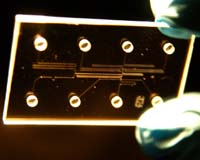
Huntsville AL (SPX) Dec 12, 2006 A unique, state-of-the-art science instrument -- one that could revolutionize how astronauts conduct chemical and biological research in space -- was launched this week aboard Space Shuttle Discovery. Developed by a science team led by NASA's Marshall Space Flight Center in Huntsville, Ala., the Lab-On-a-Chip Application Development Portable Test System, or LOCAD-PTS, is part of the STS-116 mission's science payload, bound Dec. 7 for the International Space Station. The hand-portable detection system includes a handheld diagnostic reader and set of instruments small enough to fit into a compact ice cooler. The system will help astronaut-scientists perform biological studies necessary for an extended human presence in space, from crew health and spacecraft environmental studies to the search for life on other worlds. Initially, it will provide rapid analysis to determine if certain types of bacteria are present on various space station surfaces. In the future, interchangeable system components will enable station crews to monitor their environment for contaminants such as yeast, mold and, eventually, more virulent and potentially harmful bacteria -- such as E. coli and salmonella. On the space station, the system will be tested in spring of 2007 by crew members, who will conduct surface-swabbing experiments to determine the system's effectiveness. In 2008, researchers will augment the system by delivering an air sampler unit that will permit station crew to evaluate air, as well as station surfaces, for contamination. The results will help NASA researchers refine the technology for future moon and Mars missions. The compact system, which incorporates interchangeable cartridges, is designed to serve as a mobile laboratory requiring minimal additional resources. The handheld unit weighs a mere six pounds. It is driven by technology developed by Charles River Laboratories of Wilmington, Mass., and modified for space applications by researchers at the Marshall Center. "Because the system is small, lightweight and portable, it is a unique tool that can be placed directly in astronauts' hands, improving the speed at which they can get data from days to minutes," said Ginger Flores, LOCAD-PTS project manager at the Marshall Center. The Marshall-led science team will continue to manage the research experiment once the system reaches the space station, providing operational oversight from a console in the Payload Operations Center, the Marshall-based hub for all space station science communications. Flying the portable detection system will pave the way for further development of science equipment that makes use of lab-on-a-chip technology, Flores said -- particularly applications that require such equipment to endure the harsh, unforgiving environment of space. "This team of scientists and engineers has enjoyed a unique and successful collaboration with industry to streamline the process of preparing a commercial instrument for space," Flores said. "The commitment of the team to furthering the role of humans in space is evident in their dedication to this project." On Earth, commercially adapted lab-on-a-chip technology is already in use in a variety of medical diagnostic applications, such as in-office strep tests. In space, astronauts use the lab-on-a-chip-based Portable Clinical Blood Analyzer to take blood samples, checking for proper levels of potassium, sodium and glucose during missions. Lab-on-a-chip technology allows chemical and biological processes -- previously requiring large pieces of laboratory equipment -- to be performed on small plates etched with fluid channels called capillaries. Using these channels, chemicals and fluid samples can be mixed, diluted, separated and controlled for study. NASA researchers are developing complex, portable and lightweight diagnostic chips to detect specific types of organisms, including shipboard bacteria and interesting molecular structures found in alien environments. Lab-on-a-chip instrumentation also can be adapted to monitor crew health and the environment inside their space exploration vehicle. Crew members on the space station, for example, will be able to rapidly assess microorganisms found on the orbiting science facility, helping to maintain a sterile research environment and clean air and water supplies. Because the chips are small, a large number of them can be carried on a Mars rover to search for life or carried on long-duration human exploration missions for monitoring microbes inside lunar or Martian habitats. "The information gained from this flight demonstration will be used to develop even more mature technology, enabling researchers to perform thousands of tests simultaneously in the space environment," said Dr. Lisa Monaco, lead scientist for LOCAD at Marshall. "Such a platform will enable space-based explorers to perform environmental tests, conduct crew health studies and support the search for life on Mars." The LOCAD team at the Marshall Center is collaborating with scientists at the Carnegie Institution of Washington, a private research organization, and with other NASA centers and industry partners to design chips for a variety of research and exploration applications, including the identification of microbes in self-contained life support systems. The lab-on-a-chip flight experiment is funded by NASA's Exploration Systems Mission Directorate in Washington. Community Email This Article Comment On This Article Related Links Lab-On-A-Chip Technology At NASA's LOCAD Project The latest in computer chip technology Computer Chip Architecture, Technology and Manufacture Nano Technology News From SpaceMart.com
 Magnetic Needles Turn Somersaults
 Stuttgart, Germany (SPX) Nov 29, 2006
Scientists at the Max Planck Institute of Metals Research in Stuttgart have discovered a new mechanism with which it is possible to use weak magnetic fields to reverse tiny magnetic structures, called vortex cores, quickly and with no losses. Up until now, very strong magnetic fields have been necessary to accomplish this, requiring highly complex technology. The new method might open up new possibilities for magnetic data storage (Nature, November 23rd, 2006). |
|
|

| The content herein, unless otherwise known to be public domain, are Copyright 1995-2006 - SpaceDaily.AFP and UPI Wire Stories are copyright Agence France-Presse and United Press International. ESA PortalReports are copyright European Space Agency. All NASA sourced material is public domain. Additionalcopyrights may apply in whole or part to other bona fide parties. Advertising does not imply endorsement,agreement or approval of any opinions, statements or information provided by SpaceDaily on any Web page published or hosted by SpaceDaily. Privacy Statement |